
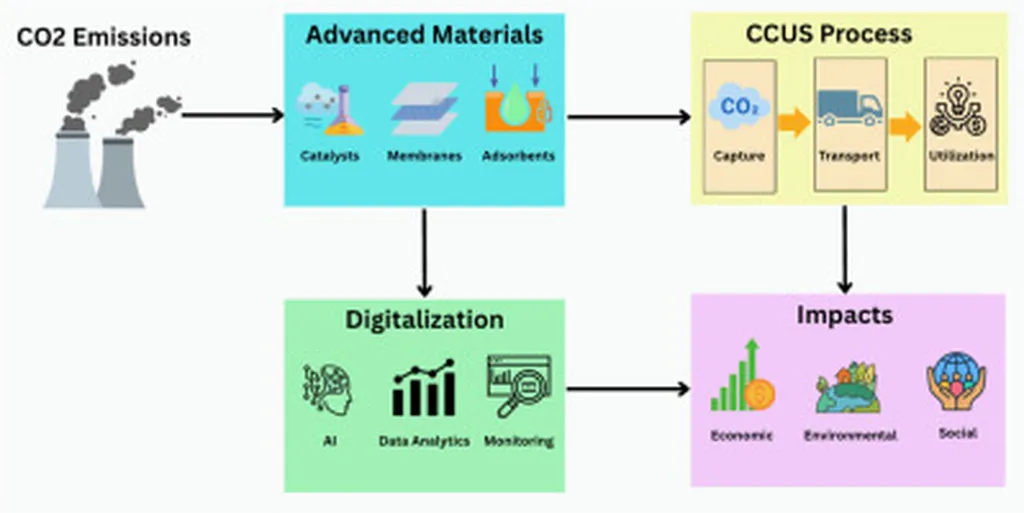
In a groundbreaking development for the energy sector, researchers have created a decision support platform that could revolutionize the way geologic CO2 storage (GCS) sites are selected. This innovation, led by Yinbang Zhou from the Petroleum Exploration and Production Research Institute at SINOPEC in Beijing, promises to enhance the efficiency, accuracy, and comparability of GCS target identification, potentially accelerating the deployment of large-scale carbon capture, utilization, and storage (CCUS) projects.
The platform, detailed in a recent study published in *Meitian dizhi yu kantan* (translated to *Modern Geology and Prospecting*), integrates three core techniques: an improved cosine similarity algorithm for case analogy, a fuzzy comprehensive evaluation model for suitability assessment, and a method for selecting favorable geobodies using 3D geological models. By constructing a quantitative case database and linking multi-source parameters, the platform offers a systematic approach to GCS siting.
“Traditional manual methods for GCS siting are often subjective and limited in scope,” explains Zhou. “Our platform shifts this process from qualitative to quantitative, significantly enhancing the objectivity and accuracy of geobody evaluation.”
The decision support platform leverages advanced algorithms to systematically scan entire data volumes, providing a unified quantitative evaluation and hierarchical ranking of various trap types such as anticlines and fault blocks. This not only improves the efficiency of GCS target identification but also ensures the comparability of results across different sites.
The practical application of this platform in the Gaoyou Sag within the Subei Basin has demonstrated its potential to provide precise, efficient digital solutions that directly support GCS siting. “This platform offers a scientific basis for formulating related policies and conducting technological R&D,” Zhou adds. “It significantly enhances the scientific rigor and prospective planning for large-scale CO2 storage deployment.”
The implications for the energy sector are substantial. As countries worldwide strive to meet their carbon neutrality goals, the need for effective GCS solutions has never been greater. This platform could reduce storage risks and costs, accelerate industrial layout, and provide key data and historical experience references for GCS siting. By offering a more objective and efficient approach, it could shape the future of CCUS projects, making them more viable and attractive for commercial investment.
As the energy sector continues to evolve, innovations like this decision support platform will be crucial in driving the transition to a low-carbon future. With its potential to enhance the accuracy and efficiency of GCS siting, this research could pave the way for more effective and widespread deployment of carbon capture technologies, ultimately contributing to global efforts to mitigate climate change.