
In a groundbreaking development that could reshape our understanding of the Moon’s geological history and open new avenues for lunar exploration, a team of researchers led by Dibyendu Misra from the Physical Research Laboratory in Ahmedabad, India, has introduced an innovative framework for detecting and quantifying lunar pyroclastic deposits (LPDs). Published in *The Planetary Science Journal* (translated as *Journal of Planetary Science*), this research promises to advance our knowledge of the Moon’s volcanic activity and its potential resources, with significant implications for future space missions and the energy sector.
Lunar pyroclastic deposits, composed of iron and titanium-bearing volcanic glasses, are crucial for understanding the primitive composition of the lunar mantle. These deposits are characterized by their low albedo and smooth surfaces, which can be identified through regional observations. However, detecting localized LPDs has been a challenge due to the overlap of their spectral signatures with common lunar minerals in the visible-to-near-infrared wavelength range.
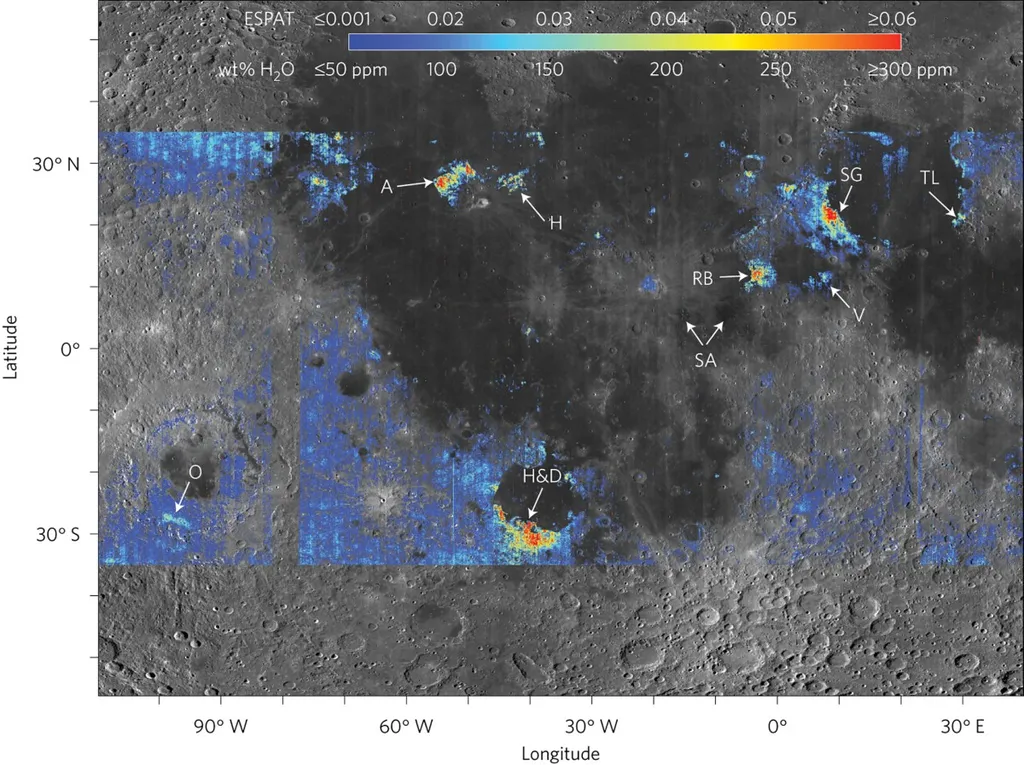
Misra and his team have developed an integrated framework that combines morphological context with a novel spectral-parameter-based false-color-composite scheme using data from the Moon Mineralogy Mapper (M^3). This approach not only identifies the spatial extent of pyroclasts but also estimates their abundance. “Our method effectively detected the spatial extent of pyroclasts with an estimation of approximately 75% volcanic glasses across the identified deposit in the Aristarchus crater region,” Misra explained. This breakthrough allows for a more comprehensive global identification and detailed quantitative analysis of LPDs.
The implications of this research are far-reaching. Understanding the distribution and composition of lunar pyroclastic deposits can provide valuable insights into the Moon’s volcanic history and its geological evolution. Moreover, these deposits could be a rich source of resources for future lunar missions. The high concentration of iron and titanium in these volcanic glasses makes them potentially valuable for in-situ resource utilization, which could support sustainable lunar exploration and habitation.
“By applying this framework to the global M^3 mosaic, we successfully detected several known localized and regional LPDs,” Misra added. The team identified five specific locations with varying concentrations of volcanic glasses, highlighting the potential for targeted exploration and resource extraction.
This research not only advances our scientific understanding of the Moon but also paves the way for commercial opportunities in the energy sector. The identification and quantification of lunar pyroclastic deposits could lead to the development of new technologies for extracting and utilizing these resources, supporting the growing interest in lunar exploration and the potential establishment of lunar bases.
As we look to the future, the work of Misra and his team offers a promising path forward. Their integrated framework provides a powerful tool for uncovering the secrets of the Moon’s volcanic past and harnessing its resources for the benefit of future space exploration. With the publication of this research in *The Planetary Science Journal*, the scientific community is one step closer to unlocking the full potential of our nearest celestial neighbor.