
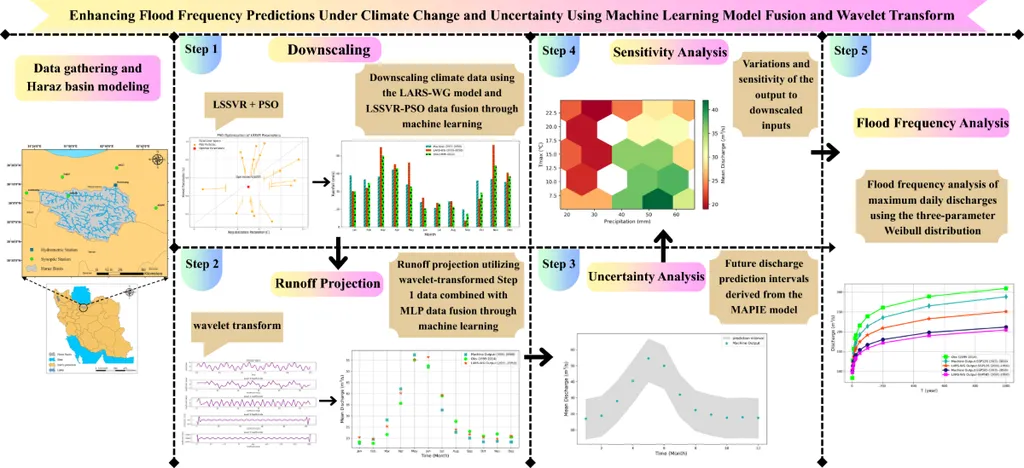
In a groundbreaking development that could revolutionize climate prediction and its applications across various sectors, a team of researchers led by A. Dwikat from the Department of Computer Engineering at Istanbul Aydin University has integrated wavelet decomposition methods with machine learning techniques to enhance the accuracy of climate variable forecasting. This innovative approach, detailed in a recent study published in ‘The International Archives of the Photogrammetry, Remote Sensing and Spatial Information Sciences’ (translated as ‘The International Archives of Photogrammetry, Remote Sensing and Spatial Information Sciences’), focuses on predicting Sea Surface Temperature (SST) patterns in the Antalya region of southeast Turkey, but its implications stretch far beyond this specific application.
The research addresses a critical challenge in climate science: the complexity of time series data. Climate data is often nonstationary, meaning its statistical properties change over time, making it difficult to predict accurately. Dwikat and his team tackled this issue by decomposing intricate climate datasets into their temporal components using wavelet decomposition. This process isolates high-frequency noise, intermediate scale variables, and long-term temporal trends, effectively simplifying the data and making it more manageable for machine learning models.
“We found that by disentangling different types of temporal variation, we could improve the extraction of feature classes and enhance the accuracy and reliability of our machine learning models,” Dwikat explained. The team compared the performance of machine learning models with and without wavelet pre-processing and reported a significant reduction in error rates when the pipeline integrated these steps. This improvement ranged from 10% to 30% across different seasons, a substantial leap in predictive accuracy.
The integration of remote sensing data further amplifies the potential of this technique. Remote sensing provides vast amounts of spatial and temporal data, making it suitable for a wide range of geospatial applications. By combining remote sensing with wavelet decomposition and machine learning, the researchers have created a powerful tool for environmental data monitoring and prediction.
The implications for the energy sector are profound. Accurate climate predictions are crucial for energy companies, particularly those involved in renewable energy. For instance, predicting sea surface temperatures can help optimize the placement and operation of offshore wind farms, which are sensitive to changes in ocean conditions. Similarly, accurate climate forecasts can aid in the management of hydroelectric power plants, where water levels and flow rates are critical factors.
Moreover, this research has broader applications in regional climate research, emergency preparedness, and agricultural decision-making. “Our results provide guidance in these areas, demonstrating how complementary approaches to satellite observations, utilizing signal processing techniques and machine learning, can collectively contribute to improved environmental data monitoring and prediction,” Dwikat noted.
The study is spatially focused within the bounds of a particular climate region, providing a detailed account of the machine learning methods used. However, the techniques developed are universally applicable and could be adapted to other regions and climate variables. This research marks a significant step forward in the field of climate science, offering a new paradigm for accurate and reliable climate predictions.
As we face the challenges of climate change, the need for precise and reliable climate predictions has never been greater. This research by Dwikat and his team at Istanbul Aydin University offers a promising solution, one that could shape the future of climate science and its applications across various sectors. The integration of wavelet decomposition, machine learning, and remote sensing data represents a powerful tool for understanding and predicting our complex climate system, ultimately contributing to a more sustainable and resilient future.