
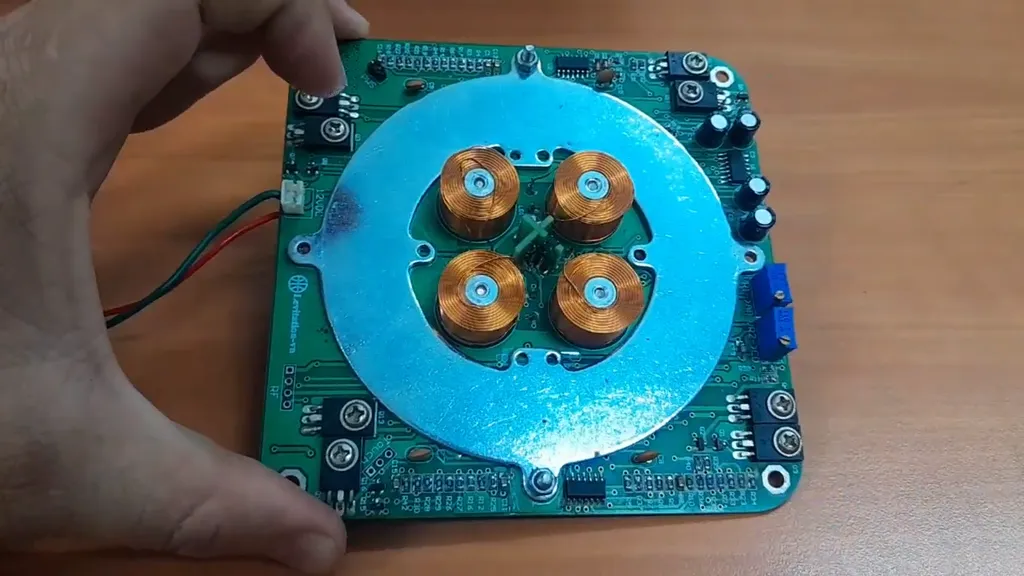
In a breakthrough that could revolutionize the energy sector, researchers have developed a novel control algorithm for magnetic levitation systems, promising enhanced stability and efficiency. The study, led by Zhenli Zhang from the School of Electrical Engineering and Automation at Jiangxi University of Science and Technology in China, introduces an improved deep deterministic policy gradient (IDDPG) controller that overcomes the limitations of traditional maglev control strategies. Published in the Journal of Engineering Science, this research opens new avenues for precision suspension technologies, with significant implications for energy-efficient transportation and industrial applications.
Magnetic levitation (maglev) systems have long been touted for their potential to reduce friction and energy loss in transportation and industrial machinery. However, conventional control methods often rely on precise mathematical models, which can be challenging to implement in real-world scenarios. Zhang’s team addressed this issue by leveraging reinforcement learning, a branch of artificial intelligence that enables systems to learn from their environment and improve over time.
“The IDDPG approach achieves robust, model-free performance while meeting the stringent real-time requirements of magnetic suspension,” Zhang explained. This means the system can adapt to variations and disturbances without needing a detailed model, making it more versatile and reliable.
The research team derived the system model from electromagnetic force balance and Newtonian mechanics, resulting in nonlinear coupled equations of coil current and air-gap displacement. These equations were linearized around the operating equilibrium to simplify controller design. The deep deterministic policy gradient (DDPG) algorithm was then examined as a model-free actor–critic reinforcement learning method for continuous control. However, recognizing its limitations in steady-state accuracy and transient response, the team introduced a segmented inverse-proportional reward function that emphasizes small air-gap errors, accelerating convergence and improving response speed.
To address hardware constraints, the team optimized training by integrating network update latency and action–state delay into a unified control cycle. This ensures stable learning while reducing iteration time and execution delay on embedded platforms. The IDDPG controller was validated through simulations and hardware-in-the-loop experiments on a test rig replicating the suspension apparatus.
Comparative studies with sliding mode control (SMC) and proportional–integral (PI) schemes demonstrated superior performance. Steady-state error was reduced below 5%, compared to 31% with SMC and 12% with PI. Under parameter variations and disturbances, the controller maintained consistent performance with fixed hyperparameters, underscoring its robustness and generalization capability. Disturbance rejection tests further showed that, compared to conventional PID control, IDDPG reduced overshoot by 51% and shortened adjustment time by 49%, yielding more stable levitation and lower mechanical stress.
This research not only improves control performance for electromagnetic suspension systems but also expands the applicability of reinforcement learning in nonlinear control. By combining targeted reward function design, workflow optimization, and experimental validation, this work demonstrates a practical pathway toward deploying model-free, learning-based controllers in maglev and other precision suspension platforms.
The implications for the energy sector are profound. Maglev systems could see widespread adoption in high-speed rail, industrial machinery, and even renewable energy technologies, where reducing friction and energy loss is paramount. As Zhenli Zhang noted, “This breakthrough could pave the way for more efficient and reliable maglev systems, ultimately contributing to a more sustainable energy future.”
Published in the Journal of Engineering Science (工程科学学报), this research marks a significant step forward in the field of control systems and reinforcement learning. The study’s findings are poised to shape future developments, offering a glimpse into a world where magnetic levitation technologies are more robust, efficient, and adaptable than ever before.