
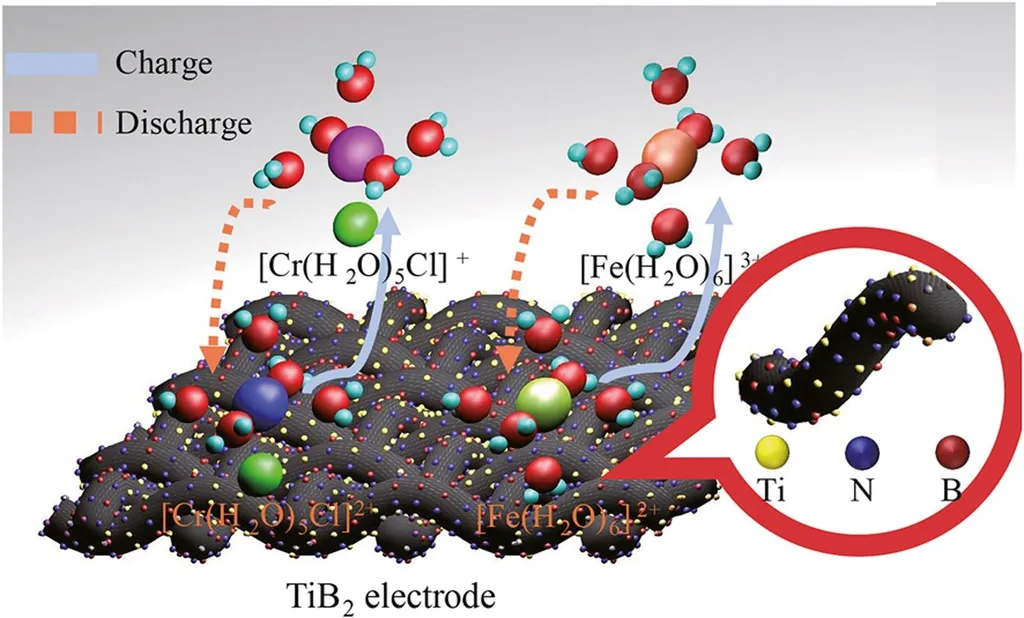
In the quest for robust, large-scale energy storage solutions, a team of researchers led by Hanwen Cui from the Faculty of Metallurgical and Energy Engineering at Kunming University of Science and Technology in China has made significant strides. Their work, published in the Journal of Engineering Science, focuses on enhancing the performance of iron-chromium redox flow batteries (ICRFBs), a technology poised to revolutionize the energy sector.
ICRFBs, known for their safety, longevity, and cost-effectiveness, are gaining traction as a viable alternative to conventional lithium-based systems. At the heart of these batteries lies the carbon electrode, a critical component that facilitates electron transport and catalytic reactions. However, traditional carbon electrodes have limitations, including insufficient active sites and poor electrolyte wettability, which hinder their overall performance.
Cui and his team have systematically reviewed recent advancements in multi-scale modification strategies for carbon electrodes, aiming to overcome these technical bottlenecks. “By introducing oxygen-containing functional groups and loading catalysts onto the electrode surface, we can significantly enhance the catalytic activity and reaction kinetics of the active species,” explains Cui. This process not only improves the battery’s charge-discharge efficiency but also extends its lifespan, making it a more attractive option for large-scale energy storage.
The modifications fall into two main categories. The first involves introducing oxygen-containing functional groups through various treatments, such as heat, acid, and plasma. These treatments regulate the surface chemistry, enhancing hydrophilicity and catalytic activity while suppressing hydrogen evolution side reactions. The second category involves loading catalysts—metallic elements, metal compounds, and non-metallic materials—onto the electrode surface. This increases the specific surface area and adsorption capacity of active species, lowering reaction energy barriers and accelerating charge transfer.
The implications for the energy sector are profound. As the world shifts towards renewable energy sources, the need for efficient, large-scale energy storage solutions becomes increasingly critical. ICRFBs, with their low operational costs and long cycle life, are well-positioned to meet this demand. By enhancing the performance of carbon electrodes, Cui’s research could pave the way for more efficient and cost-effective energy storage systems, ultimately driving the transition to a greener, more sustainable future.
However, the journey is not without its challenges. “While surface modification of carbon electrodes has shown significant advancements, a comprehensive understanding of the underlying mechanisms is still lacking,” notes Cui. The team is committed to exploring these mechanisms further, aiming to establish quantitative models that link modification strategies to performance improvements.
As the world watches, the research published in the Journal of Engineering Science (工程科学学报) could shape the future of energy storage, offering a glimpse into a future where robust, efficient, and cost-effective energy storage solutions are the norm. The work of Cui and his team is a testament to the power of innovation and the potential of scientific research to drive meaningful change in the energy sector.