
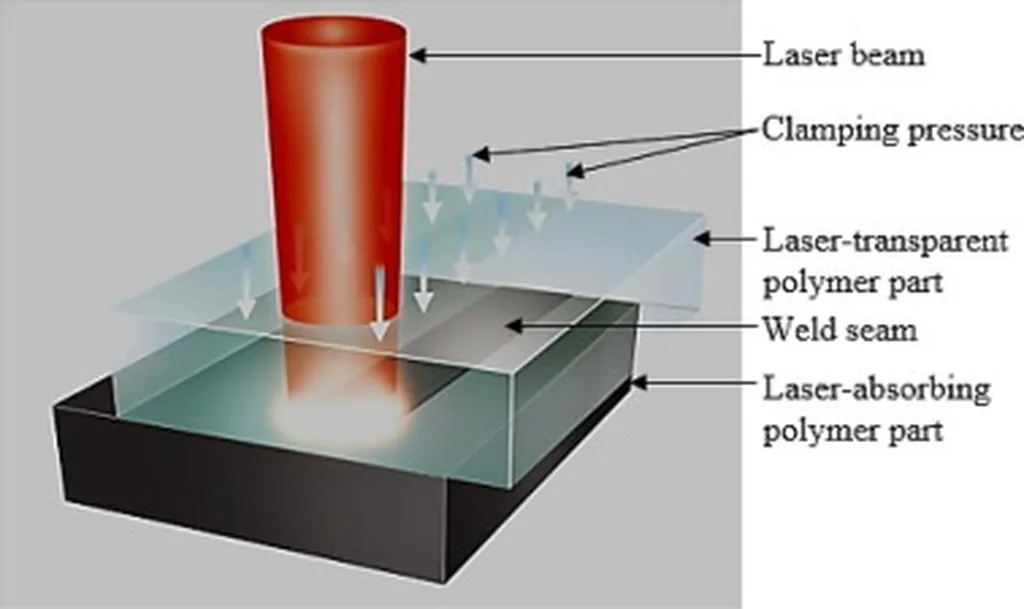
In the quest for energy efficiency, researchers are turning their attention to the often-overlooked realm of polymer welding. A groundbreaking study led by T. Pragadeesan from the Department of Energy Science and Technology at Periyar University in India has shed new light on the energy dynamics of ultrasonic welding, particularly for polypropylene (PP) and electrostatic discharge ABS (EDS-ABS) polymer blends. The findings, published in the Annals of “Dunarea de Jos” University of Galati, Fascicle XII, Welding Equipment and Technology (which translates to “Annals of the Lower Danube University of Galati”), could revolutionize the way we approach polymer welding in the energy sector.
Pragadeesan and his team embarked on an intensive experimental journey, conducting 27 meticulously scheduled experiments. They varied amplitude, weld pressure, and weld time to understand their impact on joint quality and energy consumption. The results were eye-opening. “We found a strong positive correlation between weld time and energy consumed, as well as between weld time and tensile strength,” Pragadeesan explained. This means that longer weld times not only consume more energy but also result in stronger joints. However, the relationship between amplitude and these factors was less straightforward, highlighting the complexity of the welding process.
The team didn’t stop at mere observation. They delved deeper, using the Pearson correlation coefficient to quantify these relationships and MATLAB for power signals and harmonics analysis. This allowed them to understand the variation in power signals when the process is active, providing valuable insights into the control mechanisms that could be fine-tuned for optimal ultrasonic welding.
So, what does this mean for the energy sector? Polymers are ubiquitous in energy systems, from insulation materials to components in renewable energy technologies. Efficient welding techniques can lead to significant energy savings and improved product performance. As Pragadeesan puts it, “Our findings can help create energy-efficient welding methods for polymer materials used in energy systems.”
The implications are vast. Imagine solar panels with more durable, efficiently welded components, or wind turbines with stronger, lighter polymer parts. The potential for energy savings and improved performance is enormous. Moreover, the statistical and mathematical models developed in this study could pave the way for predictive maintenance and process optimization in industrial settings.
This research is a testament to the power of curiosity and the potential of interdisciplinary approaches. By combining experimental investigation, statistical assessment, and mathematical modeling, Pragadeesan and his team have opened up new avenues for exploration in the field of polymer welding. As we strive for a more sustainable and energy-efficient future, such innovations will be crucial. The energy sector, in particular, stands to gain significantly from these advancements, making this research not just a scientific breakthrough, but a beacon of hope for a greener tomorrow.