
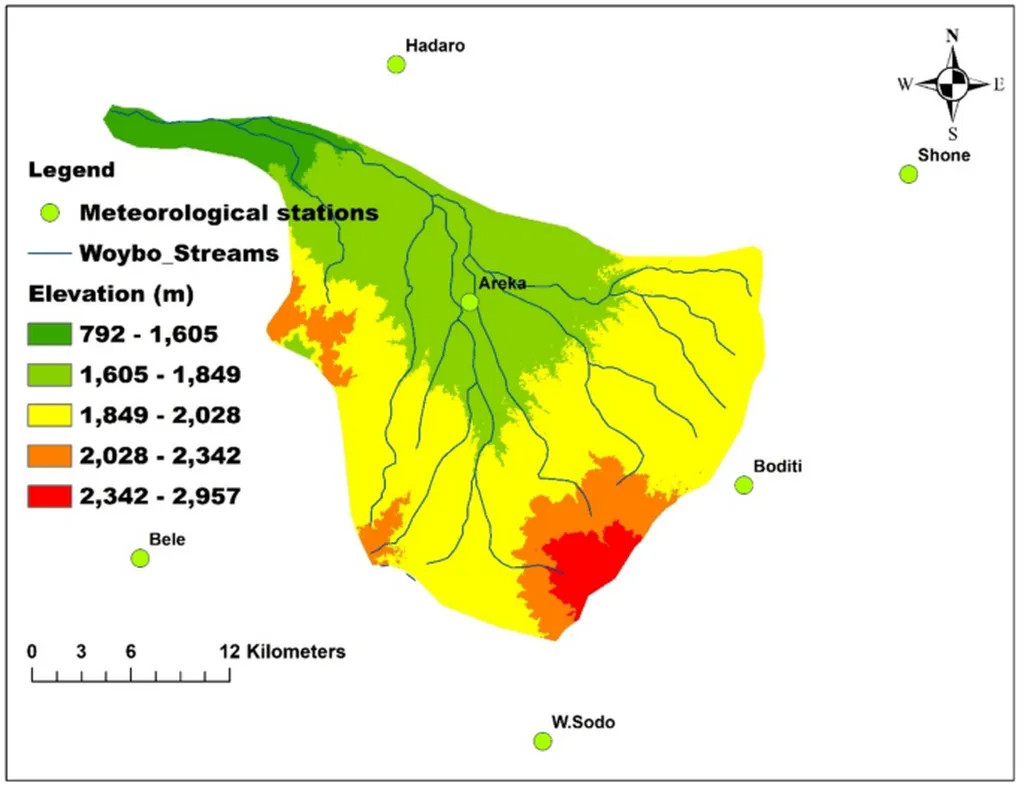
In the heart of Ethiopia’s North-Eastern highlands, a silent crisis has been unfolding, one that threatens the very land that sustains the region’s communities and industries. The Robit watershed, a vital area for agriculture and energy production, has been grappling with increasing soil erosion and sediment yield, a problem that has now been quantified and mapped with unprecedented precision. The findings, published in the journal ‘Discover Sustainability’ (translated as ‘Exploring Sustainable Futures’), offer a stark warning and a powerful tool for combating this environmental challenge.
At the forefront of this research is Weynshet Tesfaye, a dedicated scientist from the Center for Environmental Science at Addis Ababa University. Tesfaye and her team have harnessed the power of Google Earth Engine (GEE), a cloud-based platform for planetary-scale geospatial analysis, to automate the assessment of soil erosion using the Revised Universal Soil Loss Equation (RUSLE). This innovative approach has enabled the team to analyze three decades of data, from 1993 to 2023, with remarkable efficiency and accuracy.
The results are alarming. The mean annual soil erosion rate in the Robit watershed has increased from 32.5 to 41 t ha−1 yr−1, with sediment yield rising from 3 to 5 t ha−1 yr−1. “The most erosion-prone areas are bareland and grazing land,” Tesfaye explains. “This is a clear indication that land use and land cover changes are exacerbating the problem.”
The research identifies five sub-watersheds, covering 10,088 hectares, as extremely severe erosion hotspots. These areas are in urgent need of conservation action, a task that the GEE-RUSLE framework can significantly aid. By automating the integration of multi-source geospatial data, this tool offers a rapid, cost-effective, and scalable method for erosion monitoring and management.
The implications for the energy sector are substantial. Soil erosion and sediment yield can significantly impact hydropower generation, a crucial energy source for Ethiopia. Sediment deposition in reservoirs can reduce their storage capacity and efficiency, leading to power generation losses. Moreover, the environmental impacts of soil erosion can affect the social license to operate for energy projects, making sustainable land management a critical consideration for the sector.
Tesfaye’s research offers a powerful tool for informed land management, one that can be adapted to other regions with local calibration. “This framework provides a robust, data-driven approach to soil erosion assessment and management,” Tesfaye says. “It’s a tool that can help us make informed decisions and take proactive measures to combat this pressing environmental challenge.”
As the world grapples with the impacts of climate change and land degradation, Tesfaye’s work offers a beacon of hope. By harnessing the power of technology and data, we can gain a deeper understanding of our environment and take meaningful action to protect it. The GEE-RUSLE framework is not just a tool for assessing soil erosion; it’s a catalyst for sustainable land management and a step towards achieving the Sustainable Development Goals.
In the words of Tesfaye, “This is not just about quantifying a problem; it’s about empowering communities and industries to take action. It’s about creating a sustainable future for all.” As we face the challenges of the 21st century, Tesfaye’s work reminds us of the power of innovation and the importance of informed, proactive environmental management.