
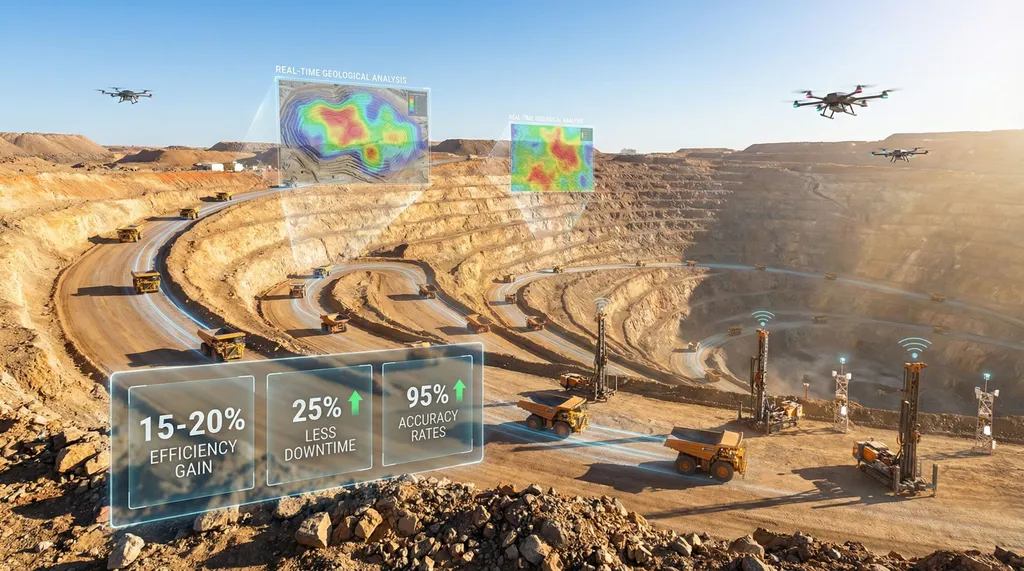
In the heart of China’s Jiangxi province, a technological revolution is unfolding, one that could reshape how the mining industry tracks and manages its most valuable resource: the earth itself. Researchers, led by Bo Zhao from the Institute of Mineral Resources at the Chinese Academy of Geological Sciences in Beijing, have developed a groundbreaking method to monitor open-pit mines using artificial intelligence and remote sensing. Their work, published in Geocarto International, translates to “International Journal of Geospatial Information and Earth Observation” in English, promises to bring unprecedented efficiency and accuracy to the energy sector.
The team’s novel deep learning algorithm, dubbed P_DEMNet, is a game-changer. It reconstructs 3D landforms directly from 2D RGB imagery, enabling substantial cost savings in downstream applications, such as estimating yearly earthwork volume. “We’ve integrated deep supervision, fractal characteristics, and uncertainty estimation in a way that’s just right for this application,” Zhao explains. This integration allows for a more accurate and reliable assessment of mine changes over time.
The implications for the energy sector are profound. The researchers focused on the Yichun mine, a significant source of lithium, niobium, and tantalum. Their estimates reveal that the mine’s open-pit parts contributed a substantial amount of these critical metals to the global market. “Our estimation shows that the yearly yield of lithium in the Yifeng mine is at least 2,410.2 tons, with the Yichun Mine’s contribution standing at 172.30 tons,” Zhao notes. The accuracy of these figures is within a narrow margin of error, thanks to the advanced AI model and post-processing workflow developed by the team.
The commercial impact of this research is immense. Accurate monitoring of earthwork volume and metal yield can lead to better resource management, improved forecasting, and more informed decision-making. “This technology can help mining companies optimize their operations, reduce costs, and increase efficiency,” Zhao says. Moreover, the ability to track changes over time can aid in environmental monitoring and regulatory compliance, further enhancing the sustainability of mining operations.
The research also introduces mining-GIS-remote sensing joint rulesets, a set of guidelines that combine the strengths of these three fields. This interdisciplinary approach is a significant step forward, as it allows for more comprehensive and accurate data analysis. “We’ve demonstrated that our method outperforms other state-of-the-art modules with nontrivial improvements,” Zhao states. This claim is backed by a series of comparative and ablation experiments, which highlight the robustness and reliability of the P_DEMNet algorithm.
As the world grapples with the challenges of climate change and the transition to renewable energy, the demand for critical metals like lithium, niobium, and tantalum is set to soar. The research conducted by Zhao and his team could not have come at a more opportune time. By providing a more accurate and efficient way to monitor and manage open-pit mines, this technology is poised to play a pivotal role in shaping the future of the energy sector.
The publication of this research in Geocarto International, a renowned journal in the field of geospatial information and earth observation, underscores its significance and potential impact. As the mining industry continues to evolve, the integration of AI and remote sensing technologies, as demonstrated by Zhao and his team, will likely become a standard practice. This shift could lead to a more sustainable and efficient mining sector, ultimately benefiting the global energy landscape.
In the words of Bo Zhao, “This is just the beginning. The potential applications of our method are vast, and we are excited to see how it will shape the future of mining and beyond.” As the world watches, the technological revolution unfolding in the heart of China’s Jiangxi province is set to redefine the boundaries of what’s possible in the energy sector.