
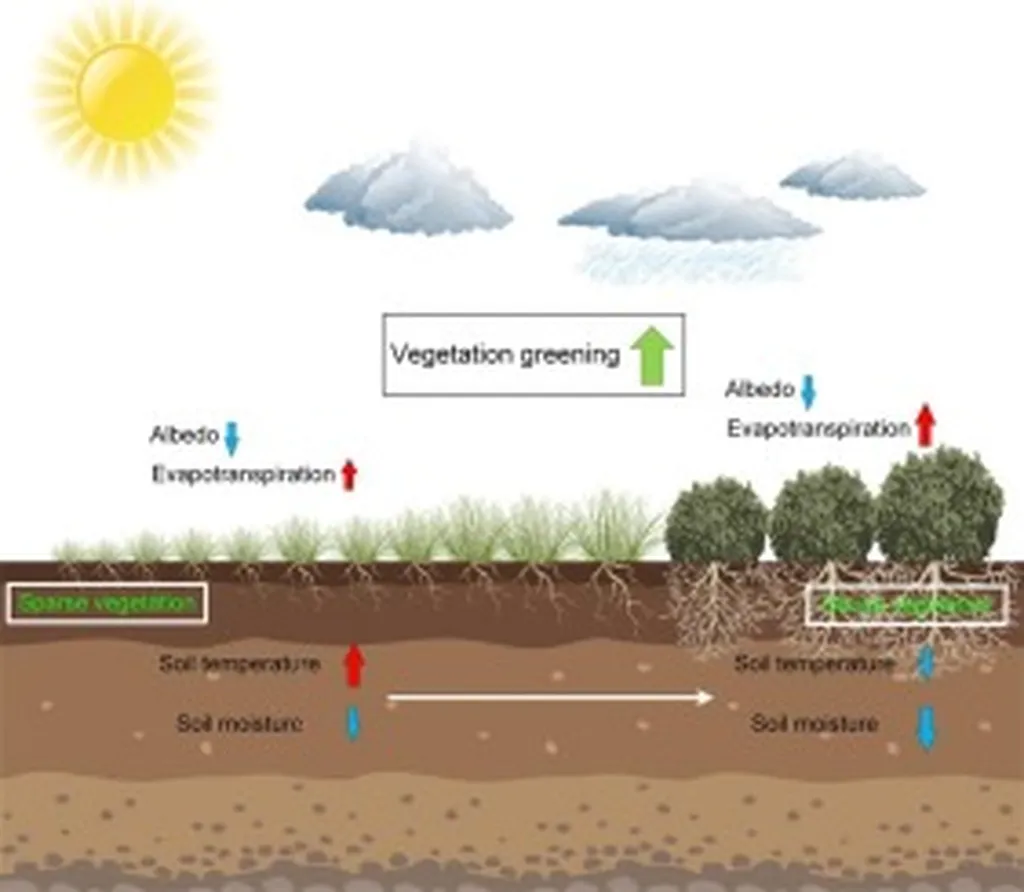
In a groundbreaking study published in the journal *Ecological Indicators* (translated from Chinese as “生态指标”), researchers have uncovered significant regional variations in how vegetation greening impacts temperatures, a finding that could reshape how we approach ecological restoration and energy management. The study, led by Jinglin Mo from the School of Geospatial Engineering and Science at Sun Yat-sen University in Zhuhai, China, highlights the complexities and uncertainties inherent in satellite observations, offering critical insights for the energy sector.
Vegetation greening, the process by which plant biomass increases, plays a pivotal role in altering regional temperatures by modifying the surface energy balance. However, the effectiveness of this greening varies widely depending on the type of vegetation and the method of observation. Mo and her team adopted a space-for-time approach to estimate temperature sensitivity variations across three key ecological restoration regions in China: Southwest China, the Loess Plateau, and Northeast China. These regions have experienced substantial increases in leaf area index (LAI) due to national ecological programs from 2003 to 2019.
The study compared biophysical impacts derived from different LAI and land use/cover (LULC) satellite products, focusing on two types of greening: growth greening (within-type LAI increase) and conversion greening (transition from openland to forest). The results were striking. “Forests exhibit the greatest uncertainty due to more complex feedbacks to surface climate,” Mo explained. “Openland-to-forest conversions produce substantially stronger cooling than greening within the same vegetation type in both land surface temperature (LST) and near-surface air temperature (T2).”
One of the most compelling findings was the difference in temperature sensitivity between LST and T2. Due to their distinct representation of energy exchange, LST sensitivity generally exhibited a 2–4 times stronger response than T2 in both greening processes. The mean sensitivity of growth greening, based on GLASS LAI and MCD12Q1, was found to be −0.32 ± 0.03 K·(LAI)−1 for LST and −0.08 ± 0.01 K·(LAI)−1 for T2. Additionally, temperature sensitivity using GLASS LAI generally estimated larger cooling magnitudes than that using BNUV6 LAI.
These findings underscore the importance of conducting multi-dataset comparisons and cross-validation when evaluating the climate benefits of ecological restoration. For the energy sector, this research offers valuable insights into how vegetation management can influence regional microclimates, potentially impacting energy demand and the efficiency of renewable energy sources. As Mo noted, “Understanding these regional variations is crucial for developing targeted strategies that maximize the cooling effects of vegetation while minimizing uncertainties.”
The study’s implications extend beyond ecological restoration, touching on urban planning, agriculture, and climate change mitigation. By providing a clearer picture of how different types of greening affect temperatures, this research could guide future efforts to optimize land use for both ecological and economic benefits. As the world grapples with the challenges of climate change, such insights are invaluable for shaping policies and practices that promote sustainable development.
In the words of Mo, “This research highlights the need for a more nuanced approach to ecological restoration, one that considers the complexities of regional variations and the uncertainties in satellite observations.” As we move forward, the findings from this study will undoubtedly play a pivotal role in shaping the future of ecological engineering and energy management.