
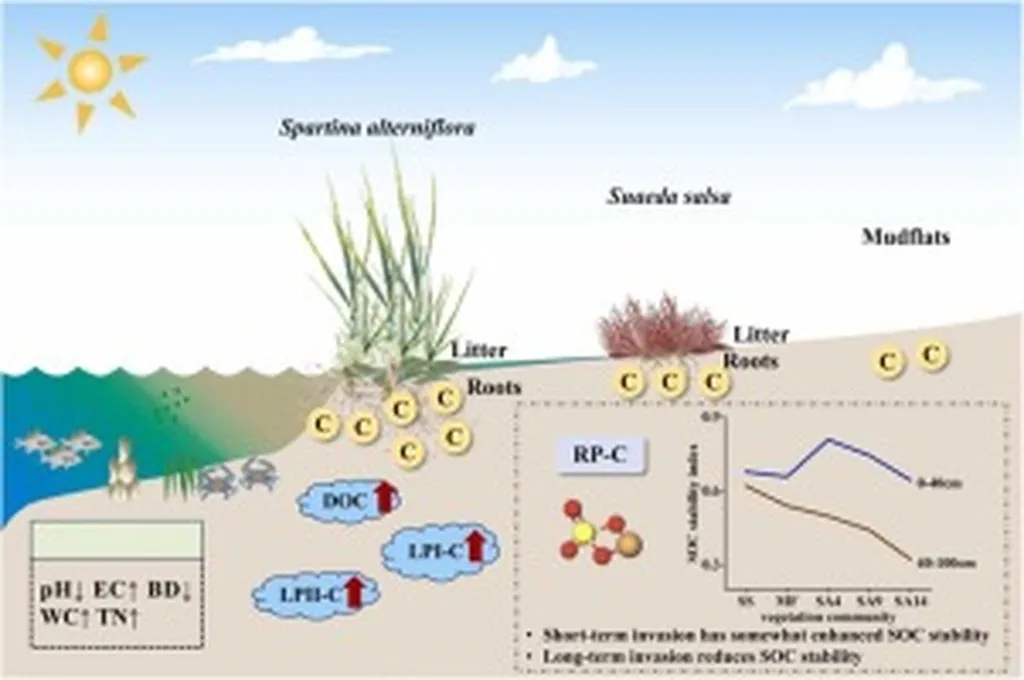
In the battle against climate change, coastal wetlands stand as unsung heroes, acting as natural carbon sinks that absorb and store vast amounts of carbon dioxide from the atmosphere. However, these ecosystems face an insidious threat: the invasion of Spartina alterniflora, a plant species that, while it may seem harmless, is altering the very soil it grows in. A recent study published in *Geoderma* (which translates to “Soil Science” in English) has shed new light on how this invasion is reshaping soil organic carbon content, with significant implications for the energy sector and carbon markets.
Qingwen Zhang, a researcher from the College of Mining Engineering at North China University of Science and Technology and the College of Harbour, Coastal and Offshore Engineering at Hohai University, led a team that delved into the intricate relationship between S. alterniflora invasion and soil organic carbon (SOC) dynamics. By collecting 114 soil samples and analyzing monthly remote sensing images, the team employed advanced machine learning algorithms to predict SOC content and assess the impact of invasion age on these vital ecosystems.
The study revealed that the correlation between SOC content and remote sensing variables varied significantly throughout the year, with June-derived variables showing the highest average correlation. “This temporal variability is crucial for understanding the dynamics of carbon sequestration in invaded wetlands,” Zhang explained. The team used a space-for-time substitution approach, which allowed them to simulate the long-term effects of S. alterniflora invasion on SOC dynamics. Their findings showed that SOC content increased with invasion age, peaking at a saturation point after 19 years. However, a slight decline was observed after 22 years, likely due to limited exchange of water, salt, and nutrients further from the coastline.
The implications of this research are far-reaching, particularly for the energy sector and carbon trading markets. As companies increasingly seek to offset their carbon emissions through natural climate solutions, understanding the long-term impacts of biological invasions on carbon sequestration becomes paramount. “Our findings provide a scientific basis for the sustainable management of coastal wetlands under invasion pressure,” Zhang noted. “This can inform policy decisions and commercial investments in carbon credits, ensuring that they are both effective and sustainable.”
The study also highlighted the importance of advanced technologies in environmental monitoring. By leveraging dense time-series remote sensing and machine learning algorithms, the researchers were able to gain unprecedented insights into the complex dynamics of soil carbon. “The integration of these technologies allows us to monitor and predict changes in soil organic carbon with greater accuracy and efficiency,” Zhang said. “This is a game-changer for the field of digital soil mapping and environmental management.”
As the world grapples with the challenges of climate change, research like Zhang’s offers a beacon of hope. By understanding the intricate interplay between biological invasions and soil carbon dynamics, we can better manage our natural resources and develop more effective strategies for carbon sequestration. The energy sector, in particular, stands to benefit from these insights, as they navigate the complexities of carbon markets and strive to meet their sustainability goals.
In the words of Qingwen Zhang, “This research is not just about understanding the past; it’s about shaping the future. By providing a scientifically robust foundation for managing invaded wetlands, we can ensure that these ecosystems continue to play a vital role in mitigating climate change and supporting sustainable development.” As we look to the future, the integration of advanced technologies and interdisciplinary research will be key to unlocking new opportunities for environmental stewardship and commercial innovation.