
In a groundbreaking development poised to revolutionize remote-sensing object detection, researchers have introduced a novel approach that promises to enhance the precision and efficiency of geospatial data analysis. This advancement, led by Youxiang Huang from the Department of Information and Computer Science at Keio University in Yokohama, Japan, addresses longstanding challenges in the field, offering significant implications for urban planning, environmental monitoring, and the energy sector.
The study, published in the IEEE Journal of Selected Topics in Applied Earth Observations and Remote Sensing (translated to English as “IEEE Journal of Selected Topics in Applied Earth Observations and Remote Sensing”), tackles the complexities of real-world remote-sensing scenarios. These scenarios often involve varying illumination, weather interference, and low signal-to-noise ratios, which can significantly degrade the performance of traditional single-modal detection methods. “Our goal was to overcome these limitations by leveraging the complementary information from multiple modalities,” Huang explained. “By doing so, we can achieve more accurate and reliable object detection in remote-sensing imagery.”
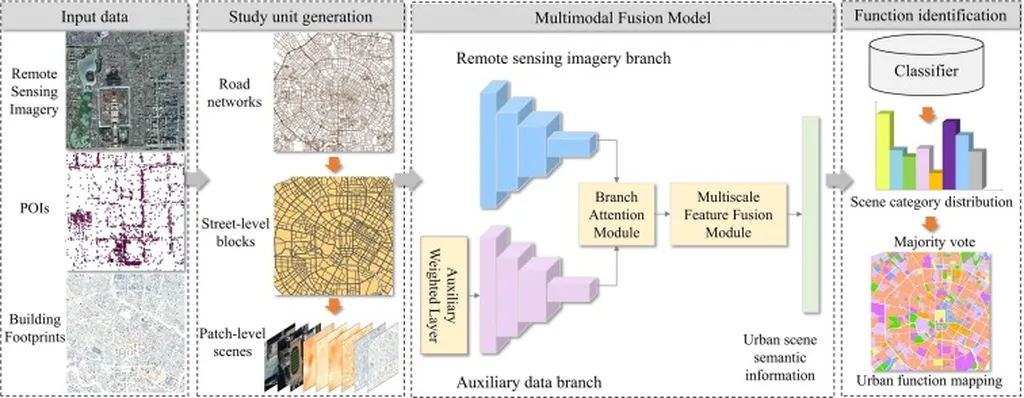
The research introduces an enhanced multimodal fusion strategy that maximizes cross-modal feature learning capabilities. This method employs a dual-backbone architecture to extract mode-specific representations independently, integrating a direction attention module at an early stage of each backbone to enhance discriminative feature extraction. “We then introduce a dual-stream feature fusion network to effectively fuse cross-modal features, generating rich representations for the detection head,” Huang added. “This approach not only improves the accuracy of object detection but also reduces computational costs by avoiding redundant fusion in complex environments.”
The implications of this research are far-reaching, particularly for the energy sector. Accurate and efficient object detection in remote-sensing imagery can enhance the monitoring of energy infrastructure, such as power lines, solar farms, and wind turbines. This can lead to improved maintenance schedules, reduced downtime, and increased operational efficiency. “The ability to detect and monitor objects with high precision in various environmental conditions is crucial for the energy sector,” Huang noted. “Our method provides a robust solution that can withstand the challenges posed by varying illumination and weather conditions, ensuring reliable data for decision-making.”
The study’s extensive experiments on the widely used vehicle detection in aerial imagery multimodal remote-sensing dataset demonstrate that the proposed method achieves state-of-the-art performance. Evaluations on single-modal datasets confirm its exceptional generalization capability, highlighting its potential for widespread application. “This research opens up new possibilities for remote-sensing object detection,” Huang said. “It paves the way for more advanced and reliable systems that can handle the complexities of real-world scenarios.”
As the energy sector continues to evolve, the need for accurate and efficient remote-sensing technologies becomes increasingly critical. This research not only addresses current challenges but also sets the stage for future developments in the field. By enhancing the capabilities of object detection in remote-sensing imagery, it contributes to the broader goal of creating smarter, more sustainable, and more efficient energy systems. The work of Huang and his team represents a significant step forward in this direction, offering a glimpse into the future of remote-sensing technology and its transformative potential.