
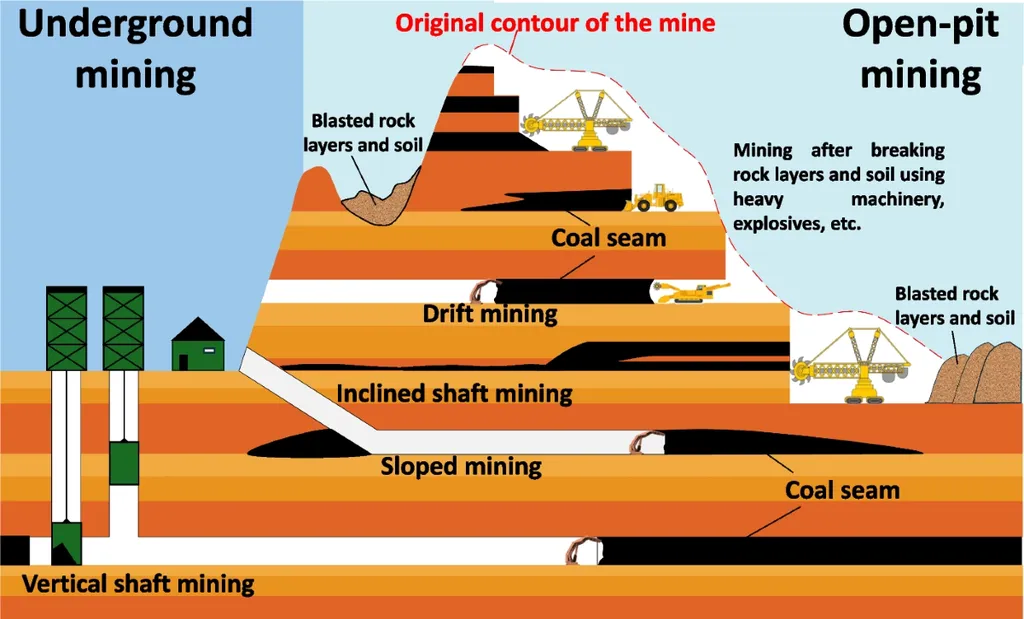
In the heart of China’s loess gully region, a groundbreaking study is shedding new light on the complex interplay between underground coal mining and the surface environment. Led by Qunjia Zhang from the Key Laboratory of Western China’s Mineral Resources and Geological Engineering at Chang’an University, this research is not just about understanding the ground beneath our feet—it’s about safeguarding the future of coal mining and the communities that depend on it.
The shift from surface to underground multi-seam mining has brought with it a host of challenges, including enhanced ground deformation and increased risks of secondary geo-hazards. Zhang and his team have been delving deep into these issues, focusing on the Hongyan coal mine to unravel the deformation mechanisms and hazard-chain evolution induced by downward multi-seam and multi-panel mining.
Their integrated approach combines Interferometric Synthetic Aperture Radar (InSAR), historical satellite imagery, UAV-based surveys, and ground observations with numerical simulations. This multi-source monitoring and modeling framework is providing unprecedented insights into the spatiotemporal evolution of mining-induced deformation.
“The monitoring results show a strong spatiotemporal correlation between mining activities and ground deformation,” Zhang explains. “Subsidence basins and temporal variations correspond closely to the mining sequence, and the spatial distribution of fissures aligns with the advancing working faces.”
The study reveals that mining-induced stress redistribution and stratum instability are the root causes of subsidence. Topography, mining sequence, and the cumulative impacts of multi-seam mining all play crucial roles in shaping subsidence characteristics. The overlying loess’s topography and characteristics, for instance, significantly influence the subsidence distribution.
One of the most intriguing findings is the evolution of the “stress arch” in the goaf—the empty space left after coal extraction. This arch evolves with the multi-panel mining process, gradually collapsing during continuous mining and leading to stratum instability. “Initially, spreading stress and preventing rock movement, the upper residual pillars aggravate stratum damage following critical stratum failure,” Zhang notes.
The implications for the energy sector are profound. As the demand for coal continues to grow, particularly in developing regions, understanding and mitigating the impacts of multi-seam mining will be crucial. This research provides a scientific basis for planning and hazard prevention, helping to ensure the safety and sustainability of coal mining operations.
Moreover, the integrated monitoring and modeling framework developed by Zhang and his team could be applied to other mining regions, offering a powerful tool for predicting and managing ground deformation and associated hazards.
Published in the journal ‘Remote Sensing’—known in Chinese as “遥感” (yáogǎn)—this study is set to shape future developments in the field. By providing a deeper understanding of the complex interactions between mining activities and the environment, it paves the way for more responsible and sustainable mining practices.
As the world grapples with the challenges of energy production and environmental protection, research like this offers a beacon of hope. It reminds us that with the right tools and insights, we can navigate the delicate balance between meeting our energy needs and preserving the planet for future generations.
In the words of Qunjia Zhang, “This study provides scientific insights for the planning and hazard prevention of multi-seam mining in loess gully regions.” And indeed, it does much more than that—it lights the way forward for the entire energy sector.