
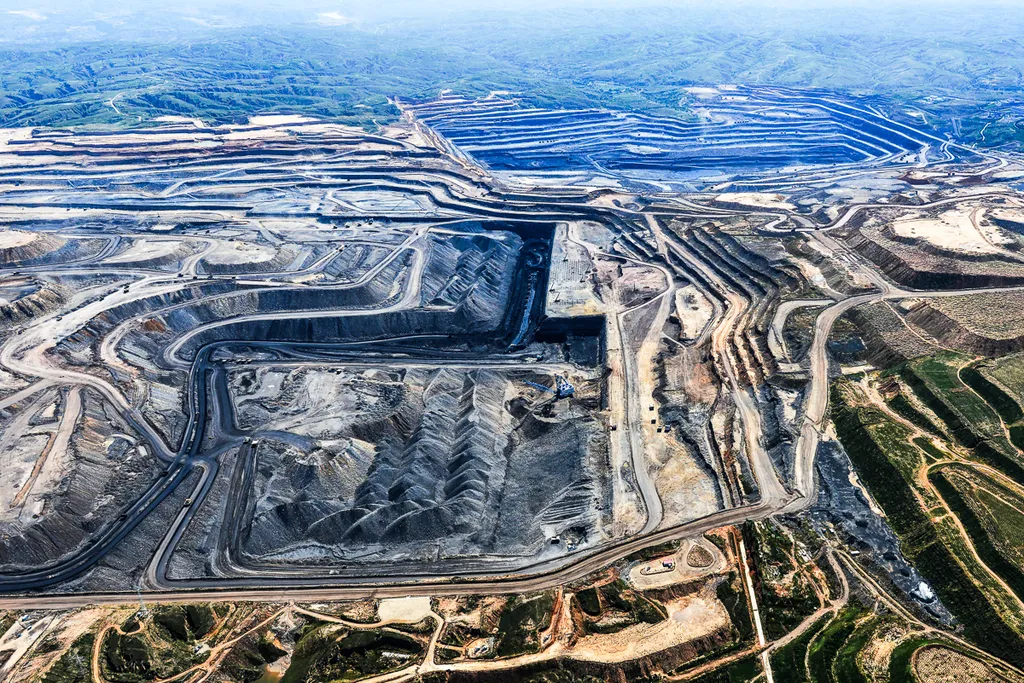
The State-owned Assets Supervision and Administration Commission (SASAC) of the State Council has released the first catalogue of industrial cultural heritage sites in the mining sector of centrally administered state-owned enterprises (SOEs). This move marks a significant step in recognizing and preserving the historical and cultural value of China’s mining industry. Among the sites listed are two from CHN Energy: the Baijigou Coal Mine of Ningxia Coal Industry and the Heidaigou Open-Pit Coal Mine of China Energy Zhunneng Group.
CHN Energy, a conglomerate with a business span across the full industrial chain including coal, power generation, transportation, and chemicals, now boasts a total of 7 national industrial heritage sites, 6 industrial cultural heritage sites of central SOEs, 4 provincial-level industrial heritage sites, and 11 group-level industrial heritage sites. These sites are not merely relics of the past; they embody the group’s development history and carry forward the spirit of industry.
The Baijigou Coal Mine, nestled deep in the Helan Mountains in Shizuishan, Ningxia, is a testament to China’s industrial prowess. Completed and put into operation in 1972, the mine has preserved its early production and living facilities, equipment, and archival records, providing a comprehensive record of its journey from construction through reform and development. The mine’s accolades include the Double Top Ten Coal Mine and Top Ten Coal Mine for Scientific and Technological Progress awards of the national coal industry, as well as the National May 1 Labor Award. In 2016, it was designated an industrial heritage site of Shizuishan.
Meanwhile, the Heidaigou Open-Pit Coal Mine, located in the central part of the Zhungeer Coalfield in Inner Mongolia, is a beacon of modern mining technology. A key project under China’s Eighth and Ninth Five-Year Plans, the mine began construction in 1990, started trial production in 1996, and commenced full operation in 1999. In 2011, it became the country’s first open-pit coal mine with an annual output of 30 million tonnes, and it currently has an approved annual capacity of 34 million tonnes. The mine is renowned for its coordination of resource extraction with environmental protection, earning it the title of China’s Most Beautiful Mine. It has issued 12 corporate technical standards, won 7 provincial- or ministerial-level awards for scientific and technological achievements, and had 24 achievements certified by the China Enterprise Confederation as new records for Chinese enterprises and institutions.
The inclusion of these sites in the catalogue is not just about preserving the past; it’s about shaping the future. As China continues to develop its mining sector, the recognition and preservation of these industrial cultural heritage sites can serve as a reminder of the industry’s roots and the spirit of innovation that has driven its growth. Moreover, these sites can provide valuable insights into sustainable mining practices, as seen in the Heidaigou Open-Pit Coal Mine’s environmental protection efforts.
The move also underscores the importance of SOEs in China’s industrial development. As the backbone of the national economy, SOEs like CHN Energy have played a pivotal role in China’s energy sector and will continue to do so in the future. The preservation of these heritage sites is a testament to their contributions and a reminder of their responsibilities in driving sustainable development.
In the broader context, this development could spark a global conversation about the preservation of industrial heritage sites in the mining sector. As countries around the world grapple with the challenges of sustainable development, the experiences and lessons learned from these sites could provide valuable insights. Furthermore, the recognition of these sites could also boost cultural tourism, providing an economic boost to the local communities.
In conclusion, the release of the first catalogue of industrial cultural heritage sites in the mining sector of centrally administered SOEs is a significant development. It not only highlights the historical and cultural value of these sites but also underscores their relevance in shaping the future of the mining industry. As the sector continues to evolve, the preservation and promotion of these sites will be crucial in driving sustainable development and fostering a deeper understanding of the industry’s rich history.