
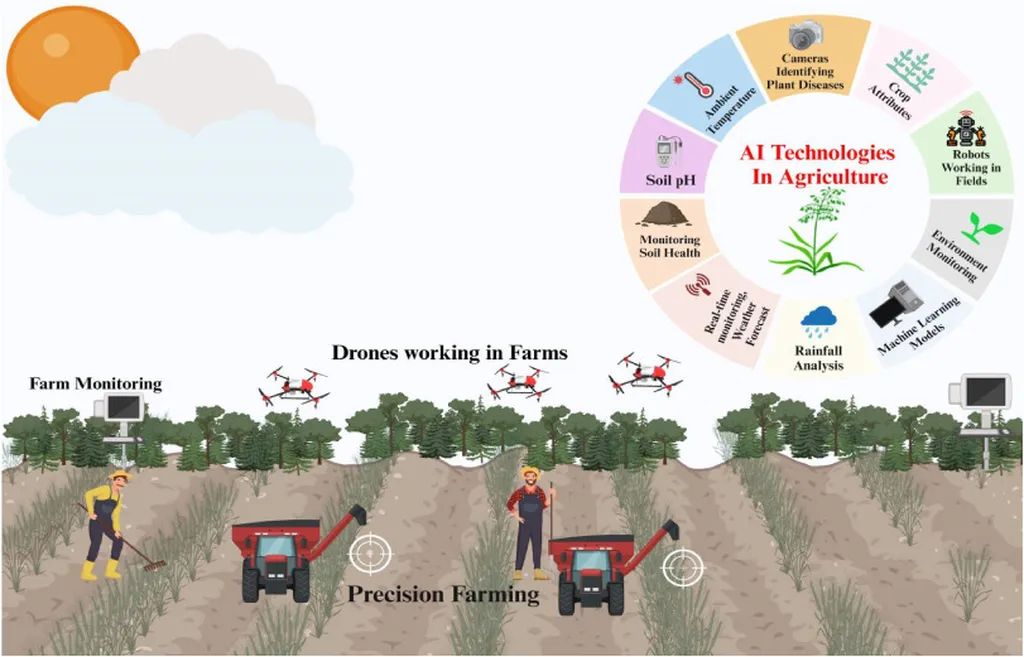
In a groundbreaking development for precision horticulture and food security, researchers have successfully mapped Pakistan’s orchards at a national scale, offering a powerful tool for yield estimation and resource planning. This innovative study, led by Ansar Ali of the Space and Upper Atmosphere Research Commission (SUPARCO) in Islamabad, leverages cutting-edge technology to address a critical gap in Pakistan’s agricultural data infrastructure.
The research, published in the journal ‘Sensors’ (which translates to ‘حاسيات’ in English), introduces an object-based Random Forest (RF) framework that integrates multi-temporal Sentinel-2 imagery with high-resolution Pakistan Remote Sensing Satellite-1 (PRSS-1) data, all processed on Google Earth Engine (GEE). This multisensory approach has yielded unprecedented accuracy in orchard delineation and yield estimation, with significant implications for the agricultural sector.
“Accurate geospatial inventories of fruit orchards are essential for precision horticulture and food security,” explains Ansar Ali. “Yet, Pakistan has lacked consistent spatial datasets at district and tehsil levels. Our study aims to change that by providing a scalable, transferable, and operationally viable framework for orchard mapping and yield forecasting.”
The study’s findings are impressive. Among the tested classifiers, Random Forest achieved the highest performance on Sentinel-2 data, with an Overall Accuracy (OA) of 79.0% and a kappa coefficient of 0.78. This outperformed Support Vector Machines and Gradient Boosting Decision Trees, with statistical significance confirmed through McNemar’s χ² test. The integration of RF with Object-Based Image Analysis (OBIA) on PRSS-1 imagery further enhanced boundary precision, increasing the Intersection-over-Union (IoU) from 0.71 to 0.86.
The commercial impacts of this research are substantial. Accurate yield estimation enables farmers and agribusinesses to make informed decisions, optimizing resource allocation and improving profitability. “This technology can revolutionize the way we approach agriculture,” says Ali. “By providing precise data on orchard locations and yield potentials, we can enhance food security and support sustainable agricultural practices.”
The study also delved into yield modeling using field-observed data. Regression-based models revealed that mean- and median vegetation index aggregations provided the most stable predictions, with R² values ranging from 0.77 to 0.79. These findings offer valuable insights for developing robust yield forecasting models, which are crucial for market planning and risk management in the agricultural sector.
The research establishes a scalable framework that can be adapted to other regions, making it a valuable tool for global food security efforts. “This is just the beginning,” Ali notes. “The potential applications of this technology are vast, and we are excited to explore its implications for other crops and regions.”
As the world grapples with the challenges of climate change and food security, this research offers a beacon of hope. By harnessing the power of multisensory satellite imagery and advanced machine learning techniques, we can pave the way for a more sustainable and food-secure future. The study’s publication in ‘Sensors’ underscores its significance and potential impact on the scientific community and the agricultural industry.
In the realm of precision horticulture, this research marks a significant milestone. It not only addresses a critical data gap in Pakistan but also sets a precedent for other data-scarce regions. The strategic value of national satellite assets for food security monitoring cannot be overstated, and this study demonstrates their immense potential. As we look to the future, the integration of advanced technologies in agriculture will be key to meeting the growing demands of a changing world.