
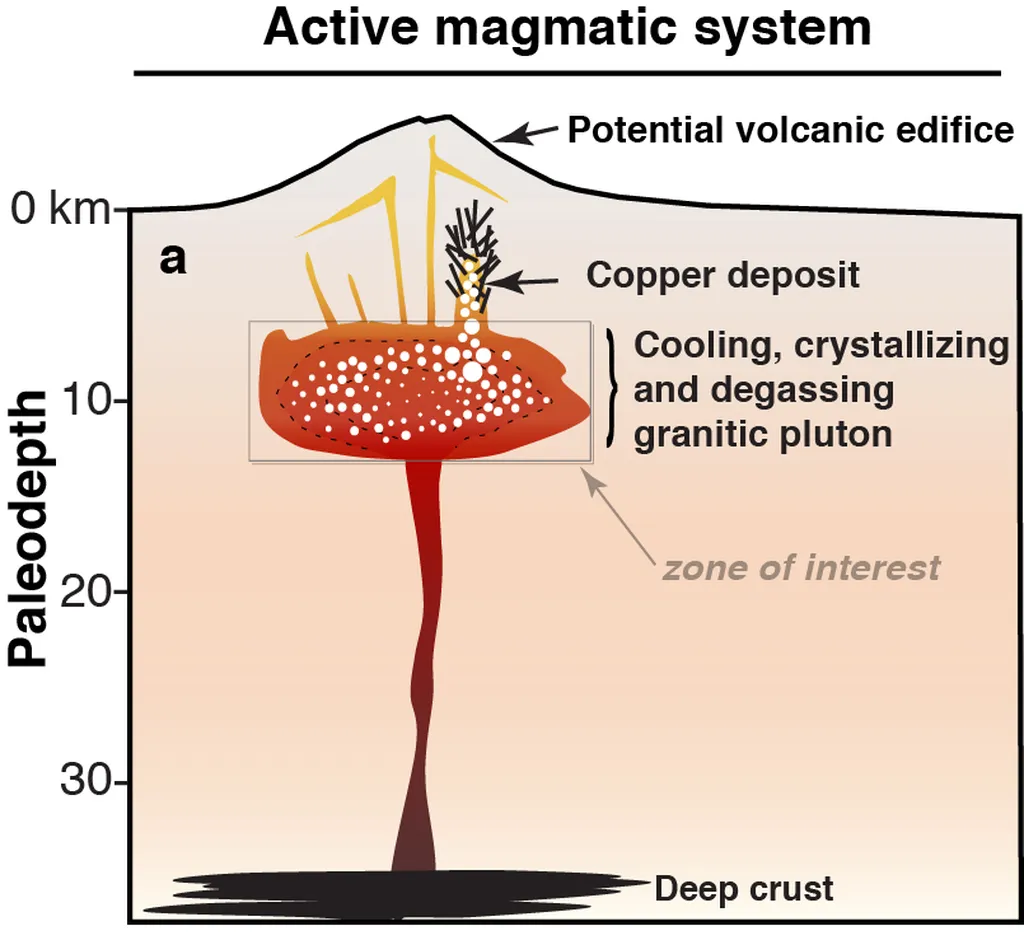
In the quest to unearth the next generation of mineral riches, a team of researchers led by Yanjun Wang from the National Key Laboratory of Uranium Resources Exploration-Mining and Nuclear Remote Sensing at East China University of Technology has made a groundbreaking discovery that could reshape our understanding of porphyry copper deposits. Their findings, published in the journal *Communications Earth & Environment* (translated as “Earth and Environment Communications”), shed new light on the factors that control the enrichment of gold in these valuable deposits, potentially opening new avenues for exploration and extraction in the energy sector.
Porphyry copper deposits are among the most significant sources of copper and gold, playing a pivotal role in the global energy sector. However, the processes that lead to the enrichment of these precious metals in these deposits have remained somewhat enigmatic. Wang and his team have now uncovered a crucial piece of the puzzle, demonstrating that the initial fertility of arc magmas in terms of chalcophile elements—elements that have an affinity for sulfur and are often associated with valuable minerals—is significantly influenced by the source processes of the magma.
The team’s investigation focused on a suite of oceanic slab-derived adakitic dikes from West Junggar, NW China. Through a combination of geochemical and petrographic evidence, they revealed that these adakitic magmas underwent sulfide segregation, a process that can significantly impact the concentration of chalcophile elements. However, their findings suggest that the variations in these elements are not solely due to magmatic evolution but are also heavily influenced by the source of the magma.
“Our results demonstrate that source processes can greatly affect the initial chalcophile element fertility of arc magmas,” Wang explained. This insight is crucial for the energy sector, as it provides a new framework for understanding the formation of gold-rich porphyry copper deposits. By recognizing the role of source processes, explorers can better target areas with high potential for valuable mineralization.
The team’s modeling further indicated that adakitic melts were initially depleted in copper and palladium but gained palladium through interaction with peridotite. This interaction highlights the complex interplay between different geological processes and their impact on the fertility of magmas. “High-degree mantle melting, combined with late sulfide saturation, produces ore-forming magmas with high chalcophile element fertility,” Wang noted. This finding suggests that under thin arcs, conditions are favorable for the formation of gold-rich porphyry copper deposits.
The implications of this research are far-reaching. By understanding the source processes that control the initial fertility of arc magmas, the energy sector can enhance its exploration strategies, potentially leading to the discovery of new, valuable deposits. This knowledge could also inform extraction techniques, ensuring that resources are utilized more efficiently and sustainably.
As the world continues to demand more copper and gold for various applications, from renewable energy technologies to electronics, the insights provided by Wang and his team are more relevant than ever. Their work not only advances our scientific understanding but also holds the promise of significant commercial impacts, paving the way for a more resource-secure future.
In the dynamic field of mineral exploration, this research marks a significant step forward, offering a fresh perspective on the processes that shape our planet’s mineral wealth. As the energy sector continues to evolve, the findings from this study will undoubtedly play a crucial role in guiding future developments and ensuring a sustainable supply of essential resources.