
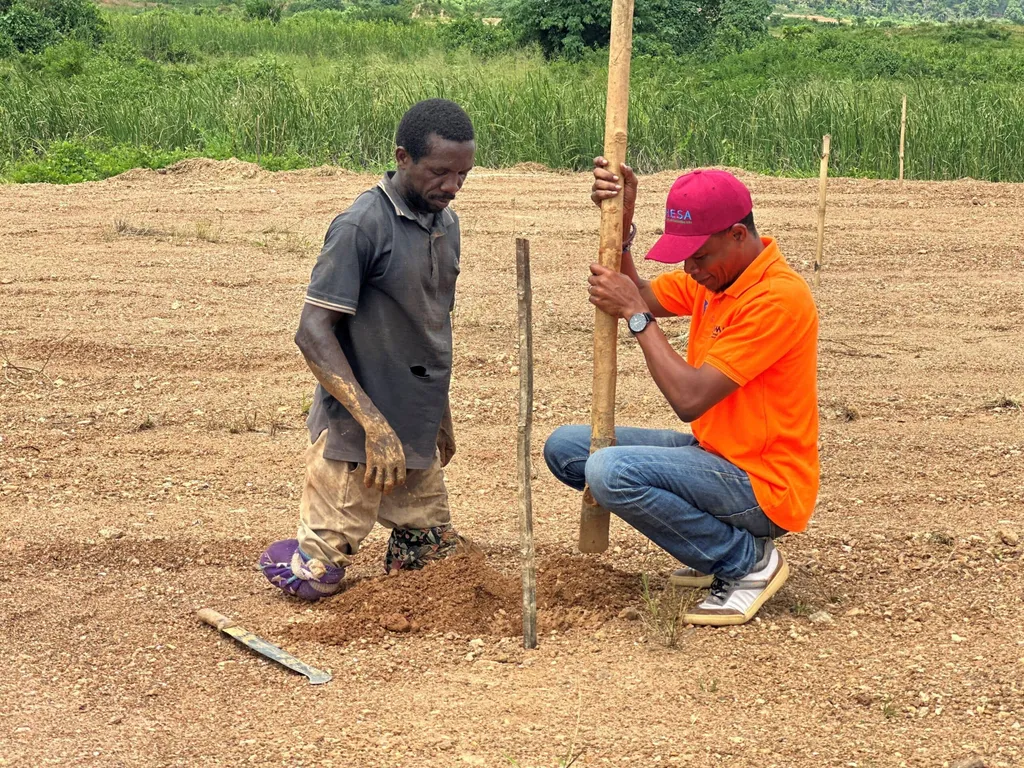
In the heart of Ghana’s Central Region, a silent battle is unfolding between the gleam of gold and the green of farmland. As mining activities expand, they are reshaping the landscape, and with it, the region’s agricultural future. A recent study published in *Sustainable Environment* (translated as *Environmental Sustainability*) sheds light on this complex interplay, offering insights that could reshape how we balance resource extraction with food security.
Clement Nyamekye, a researcher from the Department of Civil Engineering at Koforidua Technical University, has been at the forefront of this investigation. His work, published in *Sustainable Environment*, reveals a stark transformation. “From 2016 to 2022, mining and built-up areas increased by 61.9% and 22.0% per year, respectively,” Nyamekye explains. “Meanwhile, dense forests, agricultural lands, and water bodies have been shrinking at alarming rates.”
The study, which utilized remote sensing data and ground truth data, paints a vivid picture of change. Using the random forest algorithm in Google Earth Engine (GEE), Nyamekye and his team classified land use changes with precision. They found that crop loss was significantly higher in mining areas—35% compared to 18% in dominant agricultural areas. This decline in crop yield is not just an environmental concern; it’s a commercial one.
For the energy sector, which relies heavily on stable food supplies for its workforce and local economies, these findings are a wake-up call. As mining activities encroach on arable land, the region’s ability to produce food is compromised. This could lead to higher food prices, supply chain disruptions, and even social unrest. “The findings offer valuable insights to assist planners and decision-makers in formulating strategies to preserve green belts in the region,” Nyamekye notes.
The study’s use of advanced technologies like Sentinel 1 and Sentinel 2 satellites, coupled with the random forest algorithm, sets a new standard for monitoring land use changes. This approach could be replicated in other regions facing similar challenges, providing a blueprint for sustainable resource management.
As the world grapples with the dual demands of resource extraction and food security, Nyamekye’s research offers a timely reminder of the need for balanced policies. “The massive land use change from one class to another is a clear indication that we need to rethink our approach to mining and agriculture,” he says.
For the energy sector, the message is clear: sustainable practices are not just an environmental imperative but a commercial necessity. As mining continues to shape the landscape, the challenge will be to ensure that the green belts of today do not become the barren grounds of tomorrow. Nyamekye’s work is a crucial step in that direction, offering a roadmap for a future where mining and agriculture can coexist harmoniously.