
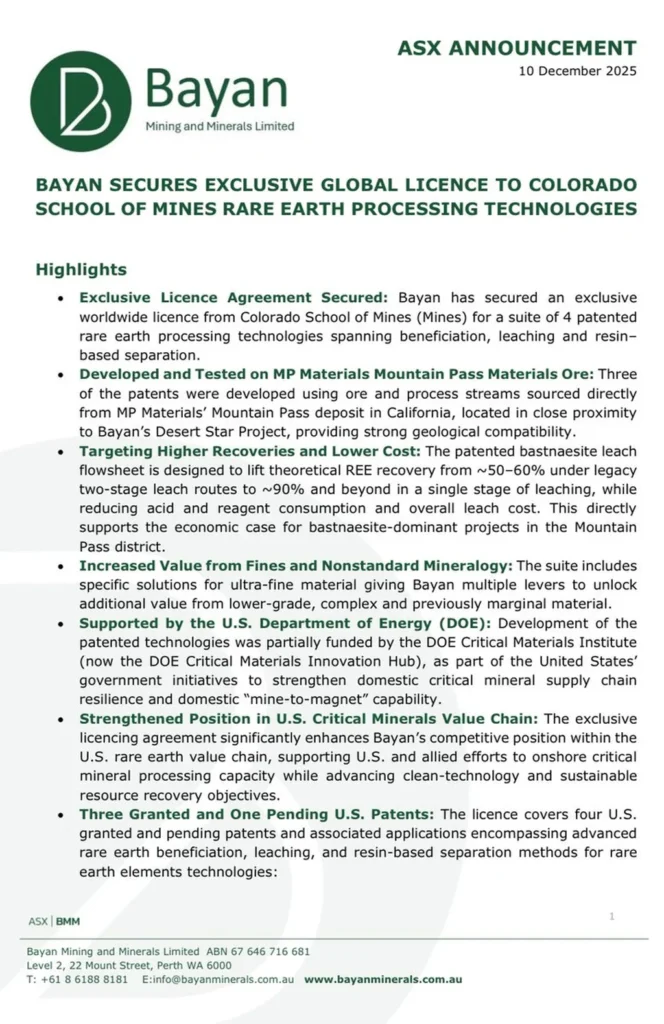
The Colorado School of Mines has struck an exclusive worldwide licensing agreement with Australian mining company Bayan Mining and Minerals Limited, marking a significant step in the advancement of rare earth element (REE) processing technologies. The agreement grants Bayan access to a suite of four patented technologies developed by researchers at the Kroll Institute for Extractive Metallurgy (KIEM) at Mines, targeting higher recovery rates and lower processing costs for bastnaesite-dominant ores.
Bastnaesite is a valuable source of light rare earth elements (LREEs) such as cerium, lanthanum, neodymium, and praseodymium, which are crucial for technologies ranging from electric motors and wind turbines to personal electronics, medical devices, and defense systems. The licensed technologies, developed and tested using materials from California’s Mountain Pass Mine—the largest REE mine in the U.S.—are particularly valuable to Bayan due to the geographical proximity and geological similarities between Mountain Pass and Bayan’s Desert Star Project.
This agreement underscores the potential for university research to transition from the laboratory to commercial implementation, addressing critical global challenges. “By translating decades of fundamental research into deployable technologies, we are enabling more efficient and sustainable recovery of critical materials that are essential to energy and advanced industries,” said Dr. Walter Copan, Vice President for Research & Technology Transfer at Colorado School of Mines. Partnerships like this ensure that innovations developed at Mines, in collaboration with federal labs, have real-world impact, delivering tangible value to society.
The four patents and associated applications cover a range of processes, including a novel single-stage leach system for rare earth extraction, novel flotation systems for separating target REEs from bastnaesite with initial gravity recoveries exceeding 90 percent, new ion-exchange methods for enhancing the purity of mixed rare earth solutions, and innovative systems for recovering ancylite, a lesser-known rare earth mineral. The Kroll Institute team, led by Dr. Corby G. Anderson, included researchers Ben Kronholm, Dr. Hao Cui, Grant Colligan, Dr. Phil Keller, Dylan Everly, Nathaneal Williams, Alex Norgren, and Professor Brock O’Kelley, with support from Dr. Vyacheslav Bryantsev and Dr. Santa Jansone-Popova of the U.S. Department of Energy’s Oak Ridge National Laboratory.
The Kroll Institute has long been a leader in addressing mid-stream processing aspects of critical minerals and metals. “Mid-stream means transforming raw mineral resources into high-purity, market-ready materials through advanced separation, beneficiation, and metallurgical processing and refining,” Anderson explained. Mid-stream processing is the critical bridge between mining and manufacturing, where value is created and innovations in efficiency, cost reduction, and environmental performance determine whether critical minerals can reliably support modern technologies and national priorities.
Development of the patented technologies was partially funded by the DOE Critical Materials Institute (now the DOE Critical Materials Innovation Hub), part of U.S. government initiatives to strengthen domestic critical mineral supply chain resilience and domestic “mine-to-magnet” capability. This license not only equips Bayan with a proprietary toolkit designed specifically for bastnaesite-dominant systems like Desert Star but also positions the company to meaningfully participate in the rapidly expanding U.S. critical minerals and downstream supply chain initiatives. “By integrating these technologies into our development strategy, we have the opportunity to unlock higher recoveries, reduce processing complexity, and accelerate the path toward producing high-quality REE concentrates in the United States,” said Bayan Executive Director Fadi Diab.
This agreement could reshape the rare earth processing landscape, potentially setting a new standard for efficiency and sustainability in the sector. As Bayan moves forward with these technologies, the mining industry may see a shift toward more innovative and cost-effective methods for extracting critical minerals, ultimately strengthening domestic supply chains and supporting advanced technologies. The collaboration between academic research and industrial application highlights the importance of bridging the gap between innovation and commercialization, ensuring that technological advancements translate into real-world benefits.