
In the ever-evolving landscape of remote sensing technology, a groundbreaking advancement has emerged that promises to revolutionize how we interpret and utilize geospatial data. Researchers, led by Yan Wang from the School of Electrical and Electronic Engineering at Wuhan Polytechnic University in China, have developed a novel neural network architecture that could significantly enhance the precision of semantic segmentation in remote sensing images. This innovation, dubbed WgANet (Wavelet-Guided Attention Network), is poised to impact various industries, particularly the energy sector, by providing more accurate and detailed insights into land cover classification, disaster assessment, and environmental monitoring.
Traditional deep learning models often overlook the critical frequency-domain information that is essential for capturing intricate textures and boundary details in remote sensing images. WgANet addresses this limitation by incorporating a unique three-branch network architecture. “Our approach integrates spatial and frequency-domain information in a way that hasn’t been done before,” explains Yan Wang. “This allows us to capture both global context and fine-grained local features, leading to more accurate and detailed segmentation.”
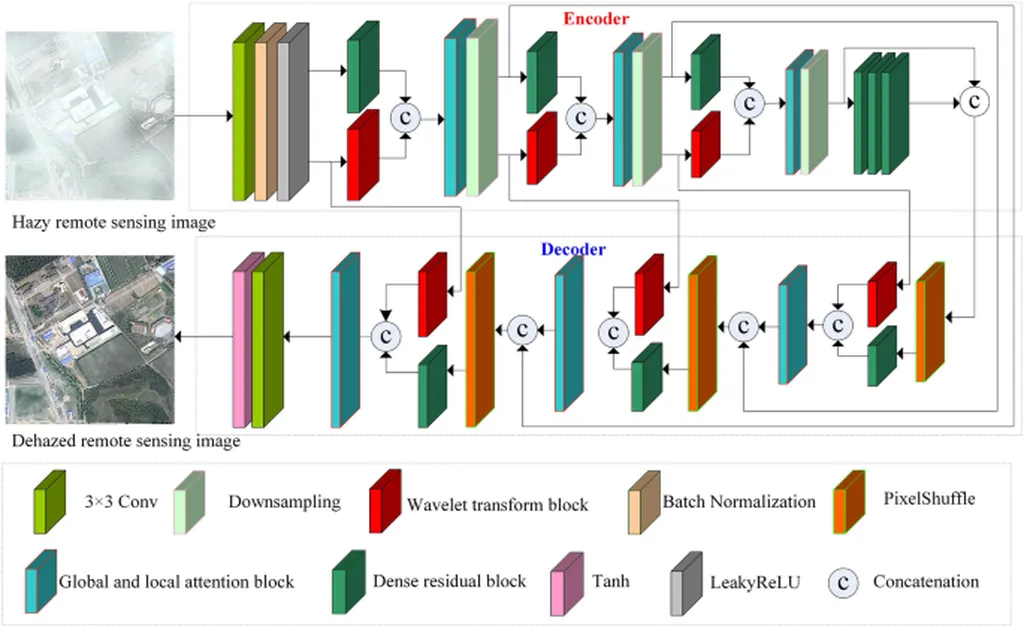
The WgANet architecture comprises three key components: a spatial Mamba branch for global context modeling, a spatial convolutional branch for local feature extraction, and a frequency band branch that utilizes wavelet-guided attention (WgA) blocks to capture frequency-aware representations. Additionally, a dynamic aggregation module adaptively fuses complementary features across all branches, enhancing semantic consistency and detail preservation.
The results of WgANet’s evaluation on high-resolution remote sensing datasets are nothing short of impressive. On the ISPRS Vaihingen dataset, WgANet achieved an overall accuracy of 91.45%, a mean F1-score of 90.50%, and a mean intersection over union (mIoU) of 83.04%. On the ISPRS Potsdam dataset, the performance metrics were even more remarkable, with an overall accuracy of 91.31%, a mean F1-score of 92.28%, and an mIoU of 86.01%. Even on the more challenging LoveDA Urban dataset, WgANet demonstrated superior segmentation performance, showcasing its effectiveness and generalization capability across complex urban scenes.
The implications of this research are far-reaching, particularly for the energy sector. Accurate land cover classification is crucial for site selection and environmental impact assessments in renewable energy projects, such as solar farms and wind turbines. Enhanced disaster assessment capabilities can improve the resilience of energy infrastructure, while precise environmental monitoring can aid in sustainable resource management. “The potential applications of WgANet are vast,” says Yan Wang. “From improving urban planning to optimizing agricultural practices, this technology can provide valuable insights that drive informed decision-making.”
The research was recently published in the IEEE Journal of Selected Topics in Applied Earth Observations and Remote Sensing, a prestigious journal that translates to “IEEE Journal of Selected Topics in Applied Earth Observations and Remote Sensing” in English. This publication underscores the significance of the work and its potential to shape future developments in the field.
As we look ahead, the integration of spatial and frequency-domain information in remote sensing image analysis opens up new possibilities for innovation. WgANet’s success highlights the importance of leveraging advanced neural network architectures to unlock the full potential of geospatial data. With continued research and development, we can expect even more sophisticated tools that will transform how we interact with and understand our environment.
In the words of Yan Wang, “The future of remote sensing is bright, and technologies like WgANet are leading the way.” As we embrace these advancements, we move closer to a world where data-driven insights guide our decisions, paving the way for a more sustainable and efficient future.