
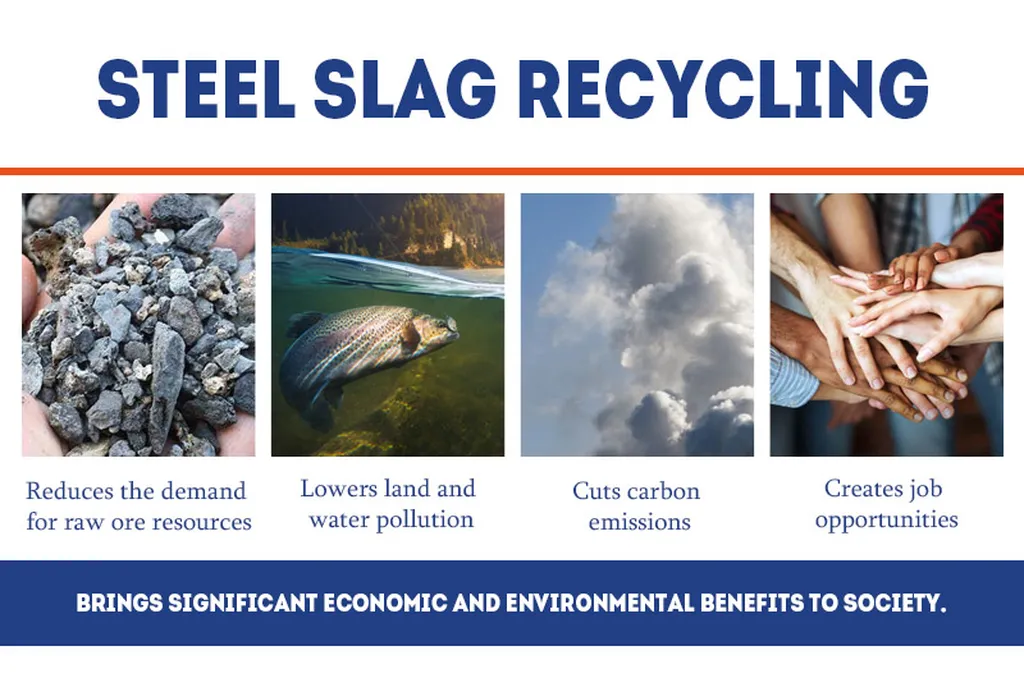
In the heart of China’s Inner Mongolia, a team of researchers led by Gang Xue at the Inner Mongolia University of Science and Technology is tackling a pressing environmental and industrial challenge: the volume stability of steel slag, a byproduct of steel production. Their work, recently published in the Journal of Engineering Sciences (工程科学学报), offers a comprehensive review of treatment methods that could revolutionize the recycling of this industrial waste, with significant implications for the energy and construction sectors.
Steel slag, a byproduct of steel production, has long been a thorn in the side of metallurgical enterprises. Its high output and low utilization rate have posed significant environmental challenges. “Poor volume stability is the primary factor hindering the large-scale application of steel slag,” Xue explains. This instability, caused by the expansion of certain compounds like free calcium oxide (f-CaO) and free magnesium oxide (f-MgO), can lead to structural issues in construction materials, limiting the slag’s potential uses.
Xue and his team delved into the volume expansion characteristics of steel slag and analyzed research progress on volume stability control from multiple dimensions. They found that both tempering methods and process methods can significantly reduce the content of active substances in molten steel slag, effectively regulating its volume stability.
For cooled solid steel slag, the researchers explored two primary forms: steel slag aggregate (SSA) and steel slag powder (SSP). Key methods for controlling SSA volume stability include aging treatment, carbonization treatment, and surface modification. While aging is currently the primary method, it has its drawbacks. “Natural aging requires a long period and lacks uniformity,” Xue notes. However, the team found that this process can be significantly shortened by applying external conditions like temperature, pressure, and humidity, although this leads to higher energy consumption and reduced SSA quality.
The pH value fluctuation method was applied to both direct and indirect carbonization treatments. Direct carbonization efficiency can be improved by optimizing temperature, pressure, CO2 concentration, and catalysts, thereby reducing SSA expansion risk. Surface modification methods, both inorganic and organic, also significantly reduce volume expansion risk, but they come with their own set of challenges.
For SSP, primary control methods include grinding, carbonization, surface modification, and combined treatments. Grinding reduces particle size, enhancing hydration activity and reducing volume expansion risk. SSP carbonization methods are diverse, with indirect methods like pH adjustment or microbial treatments achieving high carbonization efficiency without relying on traditional equipment. “Microbial carbonization, in particular, reaches efficiencies of 90%–95%,” Xue highlights.
The team also found that combining treatment methods yields better results. For instance, carbonization paired with acid treatment, alkali activation, or artificial aggregate preparation further enhances SSP volume stability compared to single treatments. Concrete made from artificial steel slag aggregate demonstrates excellent performance, mitigating the shortage of natural aggregates and holding promising potential for research and practical applications.
This research could shape future developments in the field by providing a roadmap for the large-scale application of steel slag in construction and other industries. By improving the volume stability of steel slag, the team is not only addressing an environmental challenge but also opening up new avenues for resource utilization. As the energy sector increasingly focuses on sustainability, the insights from this study could inform better practices for waste management and recycling, ultimately contributing to a more circular economy.
In the words of Gang Xue, “Our findings offer a comprehensive overview of the current state of steel slag treatment methods and highlight the potential for further innovation in this field.” As the world grapples with the challenges of industrial waste and resource depletion, this research shines a light on the path forward, offering hope for a more sustainable and efficient future.