
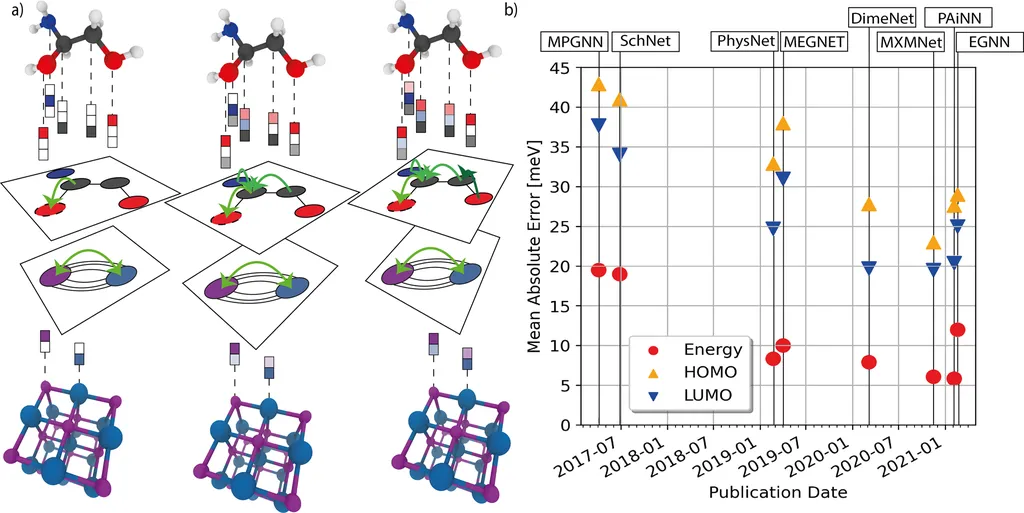
In the rapidly evolving landscape of molecular informatics, a groundbreaking review published in *Engineering Sciences Report* (工程科学学报) is set to redefine how we approach drug design and material discovery. Led by Jiaxin Dai from the School of Automation and Electrical Engineering at the University of Science and Technology Beijing, this research delves into the transformative potential of graph models in decoding the intricate relationships between molecular structures and their properties.
Molecular informatics, a burgeoning field that merges chemistry, computational science, and artificial intelligence (AI), is revolutionizing the way we predict and generate molecular properties. At the heart of this field lies molecular representation learning (MRL), a process that encodes molecular structures and properties into numerical vectors. These vectors are crucial for accurate property prediction, optimization, and generation. However, traditional methods have been hampered by their reliance on handcrafted features and the limitations of sequence-based representations like SMILES, which often fail to capture spatial and topological information.
Enter graph-based models. By treating molecules as graphs—where atoms are nodes and bonds are edges—these models can effectively utilize molecular graphs to represent complex structures and learn cross-scale features. “Graph-based MRL methods have achieved significant advancements in the prediction and generation of molecular properties,” says Dai. This shift towards graph models is not just academic; it has profound implications for industries, particularly the energy sector, where the discovery of new materials and drugs is a constant race against time and resources.
The review classifies graph models into discriminative and generative categories. Discriminative models encode topological structures and node/edge features to capture nonlinear structure-property relationships for classification and regression tasks. Generative models, on the other hand, learn from molecular distributions to optimize existing structures or design novel compounds with desired properties. This dual approach opens up new avenues for predicting physical and chemical properties, thereby accelerating the identification of suitable candidates from a vast array of potential compounds.
In the realm of material property prediction, graph neural networks are proving to be game-changers. These models are not only enhancing our ability to predict properties but also optimizing the design of new materials. For instance, in the energy sector, the ability to predict and generate materials with specific properties can lead to the development of more efficient batteries, catalysts, and solar cells, ultimately driving down costs and improving performance.
Molecular generation, another critical area, aims to learn latent distributions from limited datasets and generate novel structures that satisfy specific chemical functions. Frameworks like variational autoencoders (VAEs), generative adversarial networks (GANs), normalizing flows, and diffusion models are at the forefront of this revolution. These models are not just capturing complex molecular features but also optimizing chemical properties while preserving chemical validity. As Dai points out, “The goal is to assist molecular informatics researchers in identifying cutting-edge studies and applicable methods, while clarifying the technical pathways for AI researchers to promote more efficient algorithm design and implementation.”
Looking ahead, the research highlights several future directions for graph models in molecular informatics, including large-scale pre-training, explainable AI, and multimodal learning strategies. These advancements could pave the way for more efficient and accurate predictions, ultimately benefiting industries that rely on material discovery and drug design.
As we stand on the brink of a new era in molecular informatics, the work of Jiaxin Dai and his team serves as a beacon, guiding researchers and industry professionals towards a future where the boundaries of what is possible are continually expanded. With the insights gleaned from this review, the energy sector, in particular, stands to gain immensely, driving forward the development of innovative materials and technologies that will shape the future of energy production and storage.