
In the wake of the catastrophic 2018 Anak Krakatau eruption, a team of researchers led by Herlan Darmawan from the Laboratory of Geophysics at Universitas Gadjah Mada has unveiled groundbreaking insights into the volcano’s morphological changes. Published in *Geoscience Letters* (translated as “Geoscience Letters”), this study not only sheds light on the dramatic alterations to the volcano’s structure but also offers critical implications for the energy sector.
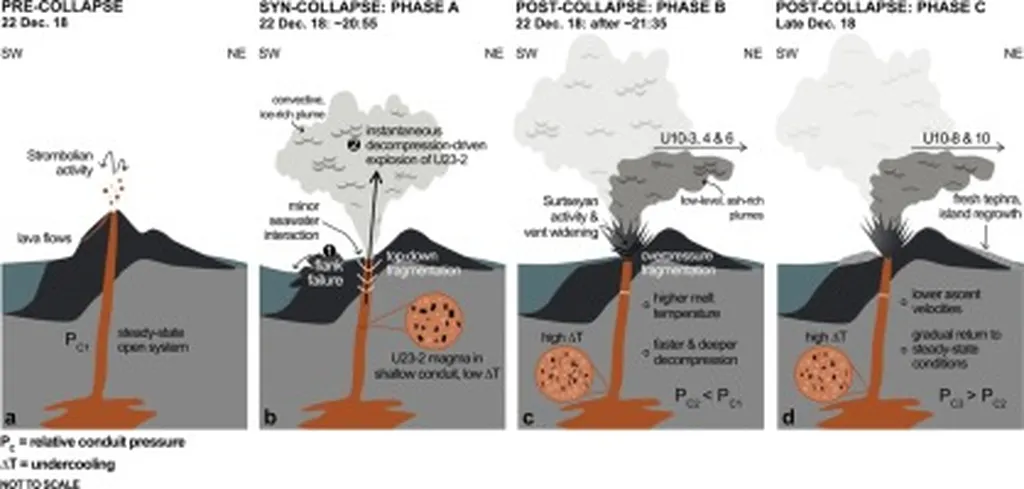
The December 22, 2018, flank collapse of Anak Krakatau triggered a devastating tsunami that claimed hundreds of lives and caused widespread destruction. Darmawan and his team meticulously analyzed satellite imagery and geological data to map the volcano’s transformation. Their findings reveal a significant reduction in the volcano’s volume and a substantial shift in its topography, which could have profound implications for future volcanic activity and hazard assessment.
“Understanding these morphological changes is crucial for predicting future eruptions and mitigating risks,” Darmawan explained. “The data we’ve gathered provides a clearer picture of how the volcano has evolved post-collapse, which is essential for both scientific research and practical applications in the energy sector.”
One of the most compelling aspects of this research is its potential impact on geothermal energy exploration. Anak Krakatau is situated in a region rich in geothermal resources, and the morphological changes documented in this study could influence the stability and accessibility of these resources. Energy companies operating in the vicinity must now consider these findings to ensure safe and efficient extraction of geothermal energy.
Moreover, the study highlights the importance of continuous monitoring and advanced modeling techniques in volcanic regions. Darmawan’s team emphasizes that real-time data and sophisticated analytical tools are vital for anticipating volcanic behavior and minimizing risks. This research could pave the way for innovative technologies that enhance the safety and sustainability of energy projects in volcanically active areas.
As the energy sector increasingly turns to renewable sources, the insights from this study become even more valuable. By understanding the dynamic nature of volcanic landscapes, companies can better assess risks and optimize their operations. Darmawan’s work serves as a reminder that scientific research is not just about uncovering the mysteries of nature but also about applying these discoveries to real-world challenges.
In the words of Darmawan, “Our goal is to bridge the gap between scientific discovery and practical application. This research is a step towards creating a safer and more sustainable future for the energy sector.”
As the energy industry continues to evolve, the findings from this study will undoubtedly shape future developments in volcanic monitoring and geothermal energy exploration. The work of Herlan Darmawan and his team at Universitas Gadjah Mada is a testament to the power of scientific inquiry and its potential to drive innovation in the energy sector.