
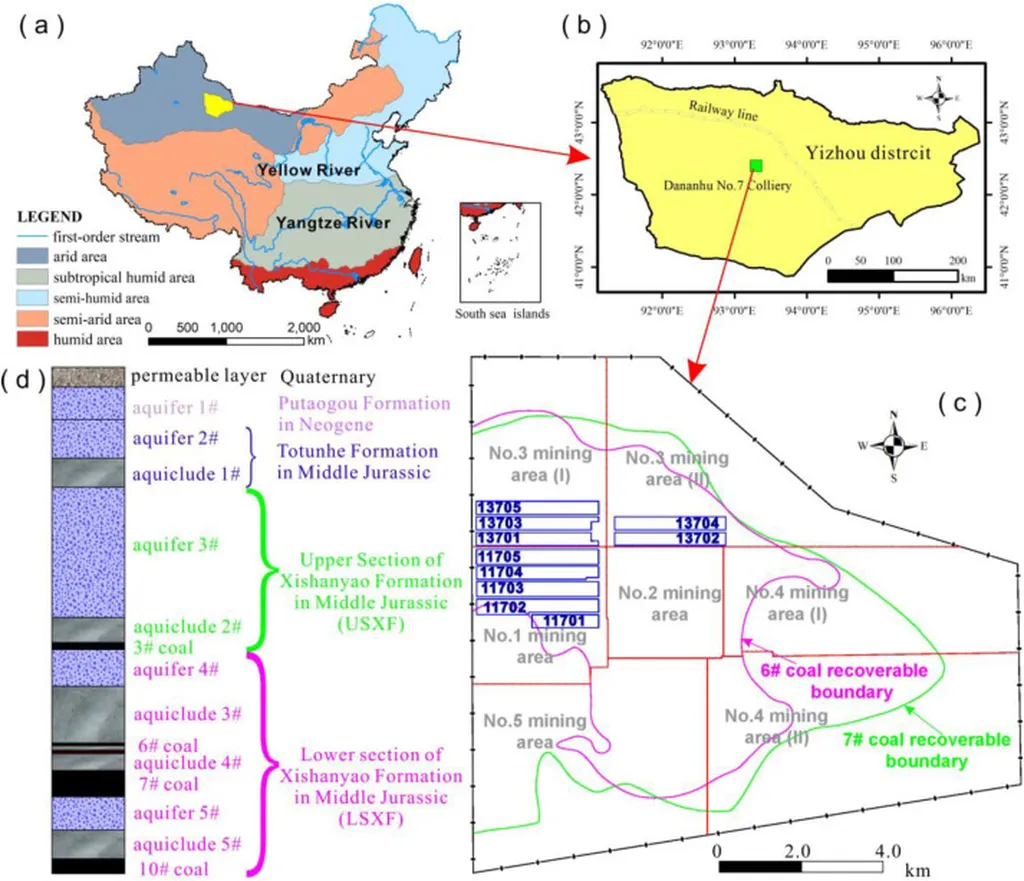
In the heart of China’s Turpan-Hami Basin, a groundbreaking study is shedding new light on the complex geology of the Dananhu Coalfield, potentially reshaping the future of coal exploration in the region. Led by Kaihua Liang from the Engineering Technology Research Center on Coal Resources Informatization of Shandong Province, the research, published in ‘Meitan xuebao’ (which translates to ‘Coal Science’), is providing a detailed roadmap for understanding the coal accumulation patterns of the Middle Jurassic Xishanyao Formation.
The Dananhu Coalfield, nestled in the southeastern part of the Turpan-Hami Basin, is known for its abundant coal resources. However, the coal seams in this area are notoriously complex, with multiple layers and varying thicknesses that have posed significant challenges for exploration. Liang’s research aims to unravel these complexities by analyzing the coal-accumulating models, paleogeography, and distribution of coal-accumulating centers of the middle member of the Xishanyao Formation.
Using borehole cores and geophysical logging data, the team identified three types of sedimentary facies: fluvial, delta, and lacustrine. The coal-accumulating swamps were found to have developed from fluvial overbanks, interdistributary bays of the delta plain, and shore-shallow lakes. Among these, the interdistributary bay swamp emerged as the most favorable coal-accumulating environment.
“The interdistributary bay swamp provided the perfect conditions for coal accumulation,” Liang explained. “The moderate subsidence rates and relatively less supply of coarse-grained sediments created an ideal environment for thick coal seams to form.”
The study revealed that the paleogeography of the middle member of the Xishanyao Formation included alluvial plains, delta plains, delta fronts, and shore-shallow lakes. Two coal accumulation centers with coal thicknesses greater than 95 meters were identified in the interdistributary bay areas.
The research also delved into the relationship between coal seam thickness, total stratal thickness, and the sandstone to mudstone thickness ratios. The findings showed that areas with moderate stratal thickness and a low sandstone to mudstone thickness ratio were associated with thicker coal seams. This indicates that the preferred coal-forming environment was the interdistributary bays, where the conditions were just right for substantial coal accumulation.
Based on these paleogeographic analyses, Liang and his team proposed that the coal accumulation centers were mainly distributed in the central area of the No.1 mine field and the central north of the F1 mine field. They established a coal accumulation model in which the swamps of interdistributary bays of the delta plain had better coal accumulation than those developed from the fluvial overbank and shore-shallow lakes.
The implications of this research for the energy sector are significant. By understanding the specific conditions that lead to thick coal seams, mining companies can more accurately target their exploration efforts, potentially increasing efficiency and reducing costs. This could have a profound impact on the commercial viability of coal mining in the region.
As the world continues to grapple with energy demands and the transition to renewable sources, studies like Liang’s provide crucial insights into the future of fossil fuel exploration. The detailed understanding of coal accumulation patterns can help optimize the use of existing resources while also guiding the search for new ones.
In the words of Liang, “This research not only enhances our understanding of the geology of the Dananhu Coalfield but also provides a valuable tool for future exploration and development in the region.” With the findings published in ‘Meitan xuebao’, the scientific community now has a comprehensive model to guide further studies and practical applications in coal mining.
As the energy sector evolves, the insights from this research could play a pivotal role in shaping the future of coal exploration and extraction, ensuring that the transition to a sustainable energy future is both efficient and informed.