
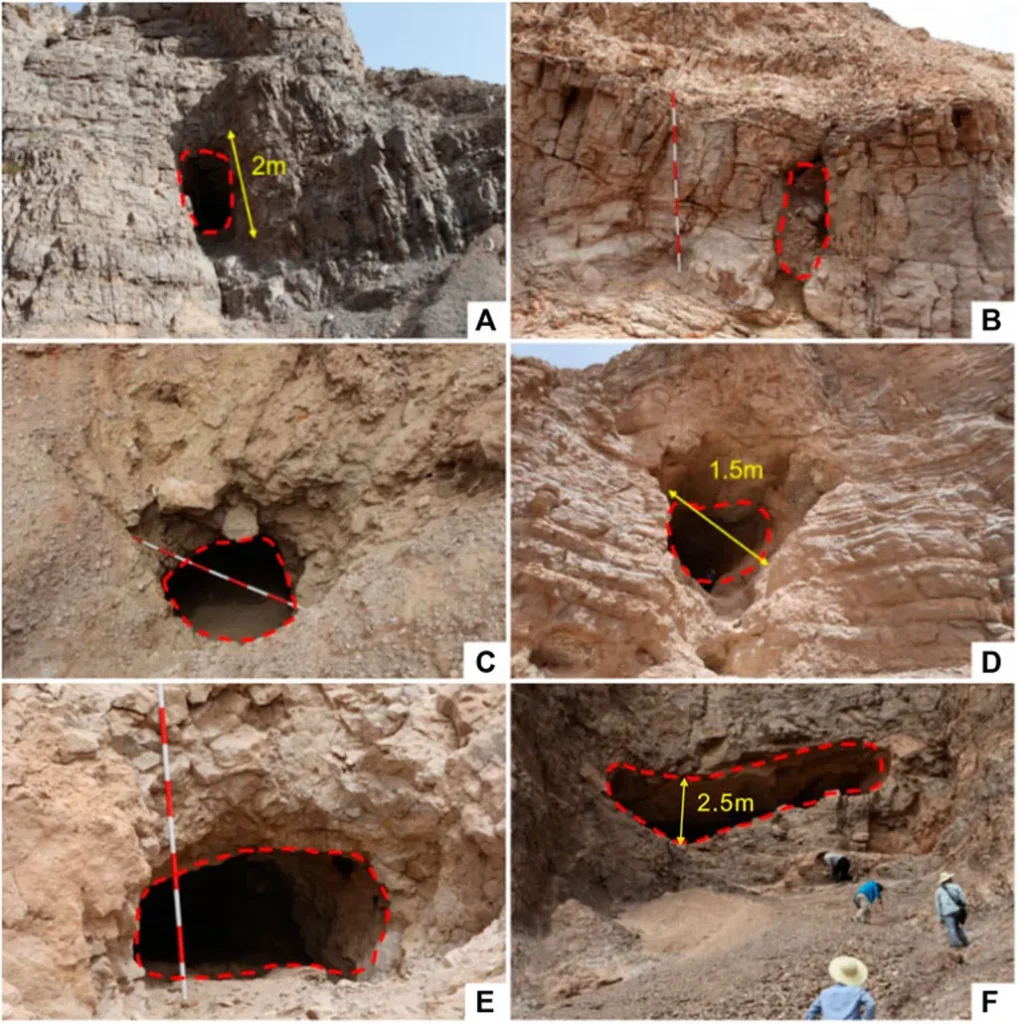
In the vast and complex world of oil and gas exploration, the Tarim Oilfield in China is making significant strides in understanding and exploiting fractured-vuggy carbonate reservoirs. A recent study led by Ruokun Huang from the Research Institute of Exploration and Development at Tarim Oilfield Company, PetroChina, has developed a novel method for interpreting acoustic reflection imaging logging data, potentially revolutionizing how these reservoirs are identified and developed.
Fractured-vuggy carbonate reservoirs are notoriously challenging to characterize due to their complex structures and the multiplicity of solutions in traditional interpretation methods. Huang’s research, published in the journal ‘Meitian dizhi yu kantan’ (which translates to ‘Geotectonica and Prospeczione’ in English), focuses on establishing a tailored interpretation method by integrating geological and geophysical characteristics specific to the Tarim Oilfield.
The study utilized numerical simulation models of three typical fractured-vuggy bodies: inter-breccia porous, fault-cavity, and tectonic-fracture types. By employing advanced techniques such as Hilbert transform-based envelope extraction and vertical constraint-based data reconstruction, the team optimized the imaging results of acoustic reflection imaging logging data. “This optimization process was crucial in enhancing the clarity and reliability of the imaging results,” Huang explained.
Using a 3D finite-difference numerical algorithm, the researchers simulated the theoretical reflection wavefields of various fractured-vuggy bodies. This allowed them to process the migration imaging results of different types of fractured-vuggy bodies and summarize their typical characteristics. “By comparing the imaging results of acoustic reflection imaging logging data with the forward modeling, we were able to identify distinct reflectors in the target interval,” Huang noted.
The study’s findings revealed three sets of reflectors characterized by clear and distinct imaging results, mutual independence, and the occurrence of arc-like pseudomorph caused by adjacent reflectors. These characteristics aligned with the imaging response characteristics of fault-cavity-type fractures, confirming the presence of high-productivity fault-cavity-type fractured-vuggy reservoirs at the interval.
The commercial implications of this research are substantial. Accurate identification and interpretation of near-well fractured-vuggy carbonate bodies can significantly enhance exploration and development efforts in the energy sector. “This method provides robust technical support for the precise identification and interpretation of near-well fractured-vuggy carbonate bodies in the Tarim Basin,” Huang stated.
The reliability of the identification of fractured-vuggy carbonate bodies based on theoretical response characteristics was validated through the processing results of actual data. This breakthrough is expected to shape future developments in the field, offering more precise and efficient methods for exploring and developing these complex reservoirs.
As the energy sector continues to evolve, innovations like Huang’s research are pivotal in unlocking new potential and optimizing resource extraction. The study’s findings not only advance our understanding of fractured-vuggy carbonate reservoirs but also pave the way for more effective and sustainable energy solutions.