
In a groundbreaking development for soil erosion monitoring, researchers have unveiled a novel approach that promises to revolutionize how we track and understand soil surface changes. Led by O. Grothum from the Institute of Photogrammetry and Remote Sensing at TUD Dresden University of Technology, this study introduces an automated, high-resolution mapping system that could significantly impact industries reliant on soil stability, including agriculture and energy.
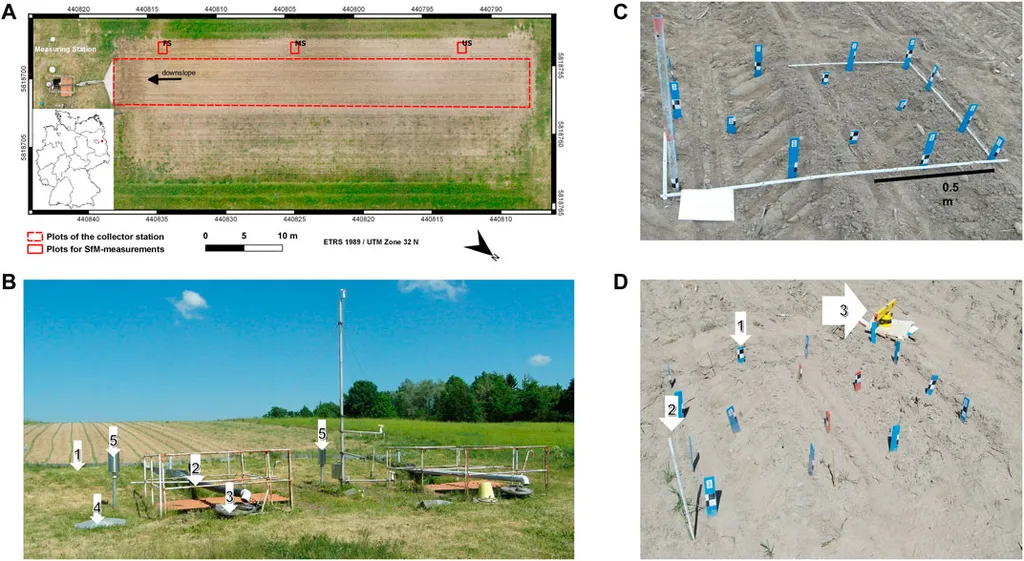
Soil erosion is a global threat, with implications for land degradation, reduced agricultural productivity, and increased sediment loads in water bodies. Traditional monitoring methods often fall short in capturing the nuanced, dynamic nature of soil erosion. Enter Grothum’s team, which has developed an event-driven, near-continuous monitoring system using time-lapse structure-from-motion (SfM) photogrammetry. This technology employs synchronized digital single-lens reflex cameras at three slope stations, triggered by a rain gauge and a daily timer, to capture high-resolution images of soil surfaces.
The system’s precision is nothing short of remarkable. “The absolute accuracy of SfM point clouds ranged between 8 and 12 millimeters on average,” Grothum explains. “This level of detail allows us to detect even subtle changes in soil surface dynamics, which is crucial for understanding erosion processes.”
The automated workflow, developed using Python, synchronizes images, detects ground control points (GCPs) with a convolutional neural network, and generates daily digital 3D surface models. These models are then used to compute 3D surface models of difference, providing a clear picture of soil surface changes over time.
The implications for the energy sector are substantial. For instance, in the oil and gas industry, understanding soil erosion patterns can be critical for pipeline stability and preventing environmental hazards. Similarly, in renewable energy, particularly wind and solar farms, soil erosion can affect the structural integrity of foundations and access roads. “This technology can help energy companies predict and mitigate erosion risks, ensuring the longevity and safety of their infrastructure,” Grothum notes.
The study, published in the journal ‘SOIL’ (translated to English as ‘SOIL’), revealed that surface changes were driven by various factors, including rainfall, snowmelt, and agricultural activity. Notably, the most significant changes often occurred shortly after tillage, even with minimal rainfall. This finding highlights the complex interplay between human activities and natural processes in soil erosion.
The monitoring system’s transferability and the high-resolution datasets it generates are expected to be invaluable for analyzing erosion dynamics and testing process-oriented soil erosion models. As Grothum puts it, “This approach opens up new avenues for research and practical applications, helping us to better manage and protect our soil resources.”
In the broader context, this research could shape future developments in soil conservation and land management. By providing a detailed, continuous record of soil surface changes, the system can inform more effective erosion control strategies and policies. For the energy sector, this means more stable and sustainable operations, ultimately contributing to a more resilient and environmentally conscious industry.
As we grapple with the challenges of climate change and land degradation, innovations like Grothum’s offer a beacon of hope. By harnessing the power of advanced geospatial technologies, we can gain deeper insights into the natural world and make informed decisions that benefit both industry and the environment.