
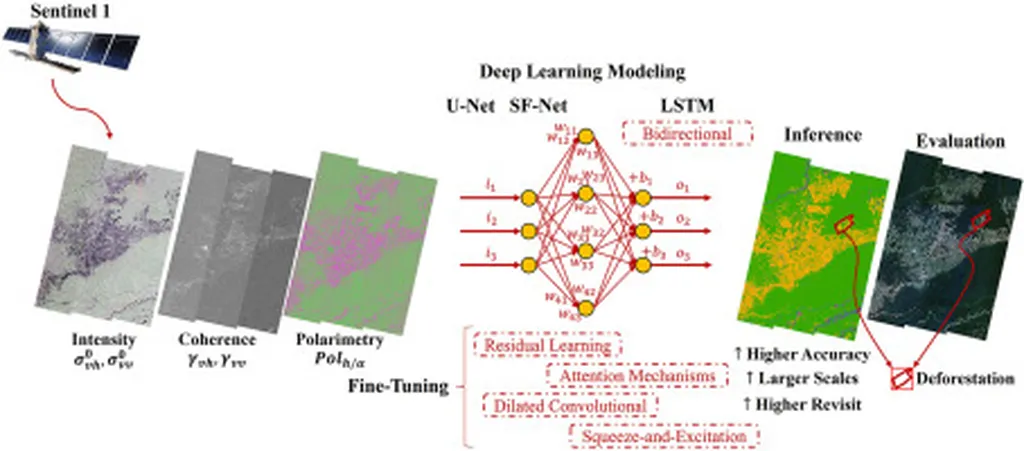
In a groundbreaking stride towards proactive forest conservation, researchers have harnessed the power of deep learning to predict near-future deforestation across the tropics. The Forest Foresight project, spearheaded by the World Wide Fund for Nature (Netherlands), has developed a model that could revolutionize how we approach deforestation, with significant implications for the energy sector and beyond.
The model, detailed in a study published in *Environmental Research Communications* (which translates to *Environmental Research Communications* in English), produces monthly risk maps at an impressive 400-meter spatial resolution, with a six-month prediction horizon. This tool is designed to identify areas at risk of deforestation before it occurs, enabling timely mitigation efforts. “Our goal was to shift from reactive to proactive conservation,” said Laura Elena Cué La Rosa, lead author of the study and a researcher at the Laboratory of Geo-Information Science and Remote Sensing, Wageningen University in the Netherlands.
The model’s predictive power was tested in 17 countries across South America, Africa, and Southeast Asia, achieving an average F0.5 score of 64.8%. This represents a modest but significant improvement over both rule-based and XGBoost decision forest models. “We saw a 4% global improvement over the baseline model, which is a step in the right direction,” Cué La Rosa explained.
The model’s performance was highest in areas near recent deforestation, highlighting its dependence on past patterns. However, this also underscores its limitation in predicting new deforestation events in previously undisturbed forests. “Our model struggles with areas where new logging roads are being developed after the prediction date,” Cué La Rosa acknowledged. To enhance prediction accuracy, the researchers emphasize the need for frequently updated, region-specific data, particularly real-time indicators of human activity.
For the energy sector, this research offers a glimpse into a future where deforestation risks can be anticipated and mitigated, ensuring a more sustainable supply chain for bioenergy and other forest-dependent industries. “By integrating these predictive tools, companies can make more informed decisions, reducing their environmental impact and mitigating risks associated with deforestation,” Cué La Rosa noted.
The study demonstrates that scalable, fine-resolution deforestation prediction is not only feasible but also crucial for empowering forest actors to engage in proactive conservation. As the world grapples with the urgent need to protect tropical forests, this research provides a promising avenue for leveraging technology to safeguard these vital ecosystems.
The findings published in *Environmental Research Communications* open new avenues for research and application, paving the way for more sophisticated models that can integrate diverse data sources and improve prediction accuracy. As Cué La Rosa put it, “This is just the beginning. The potential for further advancements in this field is immense, and we are excited to see how these tools will evolve and be utilized in the years to come.”