
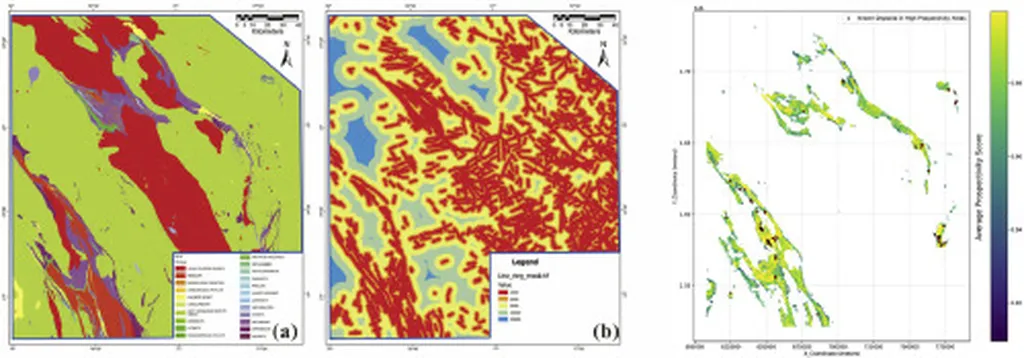
In the heart of India’s ancient Dharwar Craton, a technological gold rush is underway, not with pickaxes and pans, but with machine learning algorithms and high-resolution data. A groundbreaking study led by Soumya Mitra from the Geological Survey of India, NER, Shillong, has harnessed the power of advanced machine learning to revolutionize gold prospecting, with significant implications for the global energy sector.
The research, published in Geosystems and Geoenvironment (which translates to Geosystems and Geoenvironment), employs a hybrid knowledge-data driven paradigm, integrating ensemble and deep learning techniques to create high-resolution gold prospectivity maps. The study compares four machine learning models—Random Forest (RF), XGBoost (XGB), Support Vector Classifier (SVC), and Artificial Neural Network (ANN)—to identify the most effective tools for mineral exploration.
Mitra and his team meticulously integrated diverse geospatial data, including geological maps, structural lineaments, geochemical, geophysical, and ASTER remote sensing imagery. “We framed the task as a supervised binary classification problem,” Mitra explains, “using 79 known gold occurrences and an equal number of non-occurrence locations to train our models.”
The results were impressive. XGB and RF emerged as top performers, with AUC-ROC values of 0.9992 and 0.9965, respectively. “These models consistently demonstrated high precision, recall, and F1-scores, with few false positives or negatives,” Mitra notes. The feature importance analysis highlighted the significance of Meta-Basalt, geochemical principal component 1, and Bouguer gravity anomaly and its derivative maps.
The success-rate curves illustrated the models’ efficiency, capturing over 76% of known occurrences within just 20% of the highest-ranked areas. The combined prospectivity map, a robust synthesis from XGB, RF, and ANN, validates existing knowledge and precisely delineates high-priority exploration targets.
The commercial implications for the energy sector are substantial. As the world’s demand for mineral resources continues to grow, so does the need for sophisticated and efficient exploration methods. This research offers a blueprint for future mineral prospecting, potentially reshaping the approach to mineral exploration and contributing to a more sustainable and efficient energy sector.
Mitra’s work is a testament to the power of machine learning in geoscience. By integrating advanced algorithms with high-resolution data, researchers can uncover hidden ore bodies, optimize exploration efforts, and ultimately, meet the world’s increasing demand for mineral resources. As the world transitions to a greener energy future, the need for such innovative approaches will only grow, making this research a significant step forward in the field.