
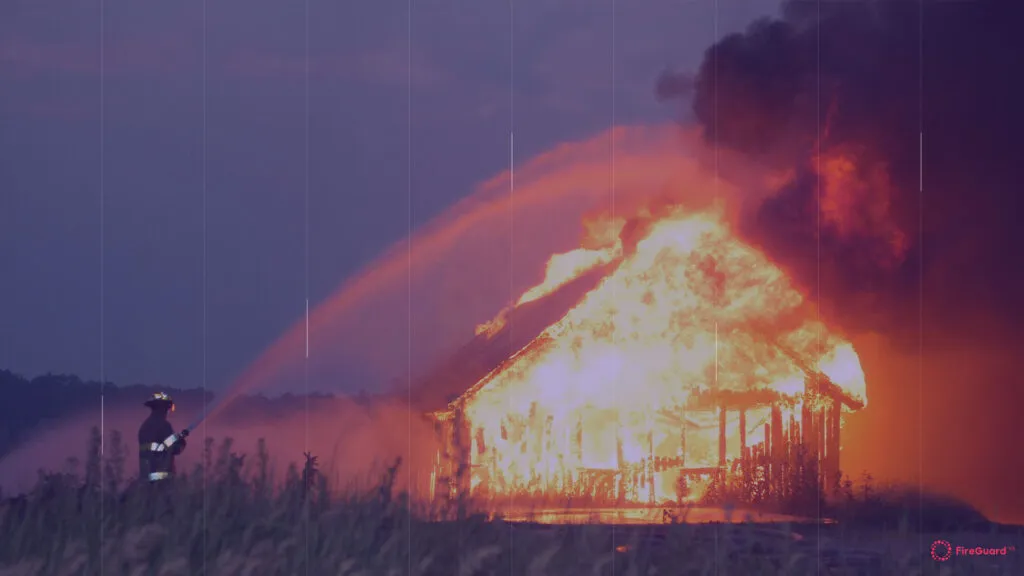
In the heart of Saudi Arabia, where the sun scorches the earth and the winds whisper through the arid landscapes, a new guardian has emerged to watch over the vast agricultural expanses. FlameGuard, an AI-driven smart map, is revolutionizing the early detection and management of agricultural fires, offering a beacon of hope for farmers and environmentalists alike. Developed by Mohammed Aljaafari, a researcher at the Department of Management Information Systems in the School of Business at King Faisal University, FlameGuard is a testament to the power of geospatial AI and transformer-based models in mitigating environmental risks.
Agricultural fires, a growing menace in arid and semi-arid regions, have long plagued farmers and environmentalists. These fires, often sparked by the intense heat and dry conditions, can spread rapidly, devastating crops and ecosystems. Traditional methods of fire detection and management have often fallen short, leaving communities vulnerable to the ravages of these infernos. Enter FlameGuard, a cutting-edge system that harnesses the power of thermal satellite imagery and advanced machine learning techniques to detect and manage fires with unprecedented accuracy and speed.
At the heart of FlameGuard lies a sophisticated geospatial AI framework that integrates a spectral rule-based model with machine learning and deep learning classifiers. “We developed FlameGuard to address the critical need for early fire detection in agricultural regions,” explains Aljaafari. “Our system uses data from the FIRMS dataset and employs a multi-model predictive architecture to classify fire confidence levels with remarkable precision.”
The results speak for themselves. Baseline models demonstrated strong performance, with Random Forest achieving 97.41% accuracy and XGBoost 98.20%. The Keras neural network further pushed the boundaries with an impressive 99.10% accuracy. But the real game-changer came with the integration of transformer-based large language models (LLMs). Minos reached a staggering 100% accuracy, while ViRanker achieved 99.63%. These models not only outperformed traditional methods but also showcased superior calibration and reliability, with efficient training and real-time inference capabilities.
The implications for the energy sector are profound. Agricultural fires not only destroy crops but also contribute to air pollution and climate change. By providing real-time visualization of fire risks and thermal anomalies, FlameGuard enables proactive environmental monitoring and early response planning. This can significantly reduce the economic and environmental impacts of fires, ensuring a more sustainable future for agricultural regions.
Comparative analysis revealed that FlameGuard surpassed NASA’s FIRMS and MODIS fire alerts, achieving 99% accuracy with sub-hour detection latency. “Our system’s ability to deliver interpretable, high-precision analytics is a game-changer,” notes Aljaafari. “It empowers stakeholders with the tools they need to make informed decisions and take timely action.”
The deployment of FlameGuard within a smart map interface further enhances its utility. This platform allows users to visualize fire risks and confidence levels in real-time, facilitating better decision-making and coordination among stakeholders. The system’s ability to integrate with IoT-ground-truth validation ensures that the data is not only accurate but also actionable.
Published in the prestigious journal Scientific Reports, this research marks a significant milestone in the field of geospatial AI and fire detection. As we look to the future, the potential applications of FlameGuard extend far beyond agricultural regions. From forest management to urban fire safety, the principles and technologies underpinning FlameGuard offer a blueprint for a safer, more resilient world.
In the words of Aljaafari, “FlameGuard is more than just a tool; it’s a paradigm shift in how we approach fire detection and management. It’s a testament to the power of AI and data-driven decision-making in addressing some of our most pressing environmental challenges.” As we stand on the cusp of a new era in environmental monitoring, FlameGuard shines as a beacon of innovation and hope, guiding us towards a future where technology and nature coexist in harmony.